Tag: tubeless tires

  • Test de résistance au roulement des pneus de gravel.

    Test de résistance au roulement des pneus de gravel.

    Enfin un test de pneus de gravel.

    Trouver le bon pneu de gravel est un défi de taille. il y a tellement de choix, de paramètres, que cela peut devenir difficile de prendre une décision.
    On peut choisir un pneu selon plusieurs critères. La résistance au roulement en est un. On peut aussi choisir un pneu de gravelle en fonction de sa fiabilité, son poids, sa facilité d’installation, le confort, son profil de crampons, le style et la couleur.

    Je me suis donc lancé dans ce projet ambitieux, afin de tester 3 modèles de pneus de gravel afin de déterminer lequel est le plus rapide, ou du moins, celui qui offre la moins grande résistance au roulement sur une surface de gravelle.

    Il existe quelques tests similaires, la plupart fais en laboratoire mais je n’en ai pas trouvé qui ont été fait dehors et sans biais de commandites ou de lien affiliés.

    Les pneus testés aujourd’hui:

    • Continental Terra Speed. 700×45
    • Vittoria Terreno Dry. 700×40
    • Panaracer GravelKing X1 2024. 700×45

    J’ai choisi ces pneus pour les raisons suivantes:
    -Le Vittoria Terreno Dry est équipé de série sur plusieurs vélo, il est donc plutôt commun.
    -Le Terra Speed a toujours été très populaire depuis sont lancement et est maintenant offert en 700×45, ce que beaucoup attendaient avec impatience. Il a la réputation d’être le pneu cramponné le plus rapide sur le marché.
    -Le Gravel King de Panaracer est un des premiers pneus de gravel ”mainstream” et la nouvelle version méritait d’être testée. C’est un pneu souvent négligé, pour plusieurs raisons. On va voir si cette nouvelle version,le X1, deviendra populaire grâce à son nouveau design de crampons. Vous pourrez lire mes premières impressions dans un autre article bientôt.

    Le test

    Il a fallu un avant midi complet pour tester les 3 pneus (en paire évidemment). J’ai donc installé 3 paires de pneus dans le stationnement du parc Frédéric Back avec une pompe réservoir (la Lezyne Pressure Overdrive). C’était un peu sportif!

    La pompe Pressure Overdrive de Lezyne
    La gauge digitale Honest de Blackburn

    Voici comment j’ai testé les 3 pneus.

    • Le montage a été fait sur la même paire de roues.
    • Largeur interne 27mm.
    • Jantes en carbone Hookless.
    • J’ai utilisé un insert dans chaque pneu.
    • Montage tubeless évidemment, avec 30ml de scellant dans chaque pneu.

    J’ai ensuite fais une multitudes de boucles du parc, donc 5.35km par tour, en respectant les conditions suivantes:

    • Un premier tour à 25km/h avec 29psi dans chaque pneu.
    • Un deuxième tour à 30km/h avec 29psi dans chaque pneu.
    • Un troisième tour à 30km/h avec 26psi dans chaque pneu.
    • Le capteur de puissance a été fréquemment calibré.

    Résultats

    Le Continental Terra Speed porte bien son nom. J’ai eu du mal à respecter la vitesse de 25km/h que j’avais planifiée pour le premier test. Et je n’ai presque pas perçu la différence d’effort requis pour passer de 25km/h à 30km/h.

    Comme c’était le premier test de la journée, supposons que j’avais de bonnes jambes.

    C’est donc le nez collé à mon Garmin que j’ai fait mon premier test.

    Le profil de crampons minimaliste.
    Le Continental Terra Speed avec flancs beiges.


    Voici les résultats:

    25km/h à 29psi:

    • Moyenne: 25.84km/h
    • Moyenne: 156 watts
    • Moyenne normalisée: 195 watts
    • Temps: 12:35
    • Temps en position assise: 12:27

    30km/h à 29psi:

    • Moyenne: 30.86km/h
    • Moyenne: 226 watts
    • Moyenne normalisée: 255 watts
    • Temps: 10:30
    • Temps en position assise: 10:16

    30km/h à 26psi:

    • Moyenne: 30.91km/h
    • Moyenne: 226 watts
    • Moyenne normalisée: 255 watts
    • Temps: 10:30
    • Temps en position assise: 9:47

    Malgré une bande de roulement aux apparences symétriques, le Continental Terra Speed est bel et bien directionnel.

    Il faut donc l’installer dans le bon sens de rotation pour en tirer le maximum de performance et de rendement.

    Conclusions

    Le Continental Terra Speed est un pneu très rapide. En effet, selon le site tirerollingresistance.com; le Terra Speed en 700×45 est plus rapide qu’une multitude de pneus de route lisses, et ce malgré la présence de crampons.

    Il faut avouer que la taille des crampons est plutôt petite. Et les crampons latéraux ne permettent qu’une faible accroche latérale. D’ailleurs, déception, le 700×45 mesure 43 sur mes jantes, qui font pourtant 27mm de largeur interne. Je suspecte que le pneu s’écrase, à basse pression, et adopte sa largeur réelle ainsi.

    Par contre, la traction et l’adhérence peut être obtenue en réduisant la pression, ce qui permet au pneu de se déformer et de mieux épouser terrain. Il n’y a aucune pénalité à réduire la pression sur le Continental Terra Speed et c’est ainsi que vous en tirerez le maximum.

    Qui sait si la résistance de roulement ne serait pas identique à une pression encore plus basse. À vous de tester!


    Vittoria Terreno Dry

    Le Vittoria Terreno Dry, présenté ici dans sa version 2.0, est un pneu relativement passe-partout et efficace. Un look sobre, un design de crampon hybride, avec accroche latérale cramponnée et une bande de roulement relativement lisse.

    On remarque, visuellement, que la bande de roulement est relativement épaisse, ce qui met en confiance coté résistance aux crevaisons.
    Depuis que Vittoria a adopté le standard ETRTO, leur pneu sont devenus très facile à installer en montage Tubeless et sont très fiables.

    Surprise, Le 700×40 mesurait 42 sur mes jantes. C’est aussi le seul pneu avec un profil relativement ”carré”, qui s’écrase à plat sur le terrain, comme un boyaux.

    On remarque le design polyvalent du Terreno Dry.
    Le Terreno Dry avec flancs beiges.

    Voici le tableau des résultats.

    25km/h à 29psi:

    • Moyenne: 25.89km/h
    • Moyenne: 163 watts
    • Moyenne normalisée: 189 watts
    • Temps: 12:16
    • Temps en position assise: 12:29

    30km/h à 29psi:

    • Moyenne: 30.64km/h
    • Moyenne: 236 watts
    • Moyenne normalisée: 261 watts
    • Temps: 10:34
    • Temps en position assise: 10:25

    30km/h à 26psi:

    • Moyenne: 30.58km/h
    • Moyenne: 243 watts
    • Moyenne normalisée: 266 watts
    • Temps: 10:31
    • Temps en position assise: 10:25

    Le vittoria Terreno Dry est aussi un pneu qui a été conçu avec un sens de rotation.
    On peut facilement voir les crampons latéraux, qui donnent au pneu son caractère rassurant en virage.

    Conclusion

    Le Terreno Dry de Vittoria est un excellent pneu ”all-around” qui cependant, donne des résultats de résistance au roulement un peu plus élevés que le Terra Speed.
    C’est aussi le seul pneu dont la résistance au roulement augmente en réduisant la pression.

    Par expérience, ce pneu est aussi très lent sur l’asphalte à une pression de 29psi ou moins. Malgré cela, c’est un pneu qui mets en confiance et qui est prévisible.

    Compte tenu que les championnats du monde de gravel ont été remportés avec le Vittoria Terreno Dry, il serait intéressant de tester la résistance au roulement à des pressions plus élevées.


    Panaracer Gravel King X1

    Je découvre le Gravel King dans sa nouvelle mouture, qui apparemment est plus raffinée, plus rapide et qui propose un cramponnage amélioré.
    Le Gravel King est un classique devenu peu populaire car beaucoup de pneus plus modernes ont pris le marché d’assault et l’engouement pour ce pneu Japonais s’est estompé au fil du temps. La première version était aussi relativement capricieuse à l’installation et exigeait patience et détermination lorsqu’on voulait le monter Tubeless. De plus, le pneu avait la réputation de projeter les petits cailloux qui se coinçaient entre les crampons vers l’arrière, ce qui rendait l’expérience plutôt pénible pour les cyclistes autour.

    Le design élaboré de crampons du X1
    Une étiquette plutôt jolie. Fait au Japon.

    Voici les résultats.

    25km/h à 29psi:

    • Moyenne: 25.89km/h
    • Moyenne: 156 watts
    • Moyenne normalisée: 185 watts
    • Temps: 12:36
    • Temps en position assise: 12:00

    30km/h à 29psi:

    • Moyenne: 30.43km/h
    • Moyenne: 227 watts
    • Moyenne normalisée: 255 watts
    • Temps: 10:32
    • Temps en position assise: 10:13

    30km/h à 26psi:

    • Moyenne: 30.85km/h
    • Moyenne: 224 watts
    • Moyenne normalisée: 247 watts
    • Temps: 10:28
    • Temps en position assise: 10:06
    La flèche qui indique le sens de rotation.

    Le pneu Gravel King X1 est aussi directionnel. Malgré la taille minimaliste de la flèche, le design de crampon permet tout de même de facilement deviner le sens de rotation.

    Le Gravel King X1 s’est avéré le pneu le plus difficile à installer.

    Conclusion

    Le nouveau Gravel King est un pneu surprenant! Confortable et prévisible, offrant une accroche latérale surprenante. Idéal pour ceux qui recherchent un pneu qui mets en confiance, particulièrement en virage sur gravelle douce.

    En chiffres: ce pneu, comme le Terra Speed, s’est avéré un peu plus rapide à plus basse pression. La sensation à plus basse pression était excellente. On peut sentir le pneu se déformer et mordre dans la gravelle ce qui donne cette sensation rassurante et prévisible.

    Je n’ai pas eu le temps de tester la gomme sur l’asphalte, alors je mettrai à jour cet article éventuellement.

    Aussi, Il semblerait que Panaracer a amélioré son design de crampons: le nouveau Gravel King ne lance (presque) plus de cailloux vers l’arrière.


    Et le gagnant est…

    Considérant l’infime écart qu’il y a entre chaque modèle, est-ce réaliste de déclarer un gagnant? Probablement pas.

    Après tout, ce test n’est probablement pas le plus fiable, puisqu’il faut prendre en compte le vent qui varie constamment, l’achalandage des autres usagers du parc, puis ma fatigue cumulée au fil des tests qui influence ma perception.

    Si on observe seulement les données obtenues (en watts), on peut classer ex-aequo, au premier rang, le Continental Terra Speed et le Panaracer Gravel King.

    À prendre avec des pincettes.

    Plus de Graphiques!

    Comparaison des courbes de puissances à 25km/h – 29 psi
    Comparaison des courbes de puissances à 30km/h – 29psi
    Comparaison des courbes de puissances à 30km/h – 26psi

    Comparatif final (non-corrigé)

    Panaracer Gravel King X1

    • Moyenne: 30.85km/h
    • Moyenne: 224 watts
    • Moyenne normalisée: 247 watts
    • Temps: 10:28
    • Temps en position assise: 10:06
    • Facilité de montage:
      3/5
    • Taille annoncée: 700×45
    • Taille mesurée: 700×44

    Continental terra Speed

    • Moyenne: 30.91km/h
    • Moyenne: 226 watts
    • Moyenne normalisée: 255 watts
    • Temps: 10:30
    • Temps en position assise: 9:47
    • Facilité de montage:
      3/5
    • Taille annoncée: 700×45
    • Taille mesurée: 700×43

    Vittoria Terreno Dry

    • Moyenne: 30.58km/h
    • Moyenne: 243 watts
    • Moyenne normalisée: 266 watts
    • Temps: 10:31
    • Temps en position assise: 10:25
    • Facilité de montage:
      4/5
    • Taille annoncée: 700×40
    • Taille mesurée: 700×42

    Comparatif du data à 30km/h – 26 psi

    Note importante.

    Je dois souligner que la paire de Vittoria Terreno Dry et les inserts vittoria, ainsi que le scellant, m’ont été offerts par Vittoria. C’est en partie grâce à leur aide que j’ai pu faire ce test.

    Les autres pneus ont été acheté en boutique (localement).

    Jamais Vittoria n’a eu d’influence sur le contenu produit, soit écrit ou visuel.

    J’en profite tout de même pour les remercier de leur confiance et leur support.

  • The Rift – the Icelandic bike adventure (part 1)

    The Rift – the Icelandic bike adventure (part 1)

    When Gravel cycling was still a marginal thing, (that is before Gravel became the new Fixie, aka before Gravel events became the Pros retirement plan) I came across this unique cycling event and I was hooked right away. My first thought was… cycling in Iceland? In Fact, I knew very little about Iceland, besides the usual. I did not even think there was a cycling scene over there.

    One day, GCN covered The Rift and I knew right away, after watching the video, that I had to attend one day. It sure felt like this event would become an unforgettable experience in one of the most breathtaking place on Earth.

    As Iceland is nicely situated between Canada and Europe, the event attracts people from everywhere and in growing numbers. The 2021 event had 200 participants and the 2023 version more than 500. (for the 200km distance)

    And the fact that Iceland has the potential to be cold, windy, covered with snow at any time of the year made it more attractive, even though I absolutely despise Canadian winters. It just felt like this could be a great event and a great cycling adventure.

    What makes The Rift special?

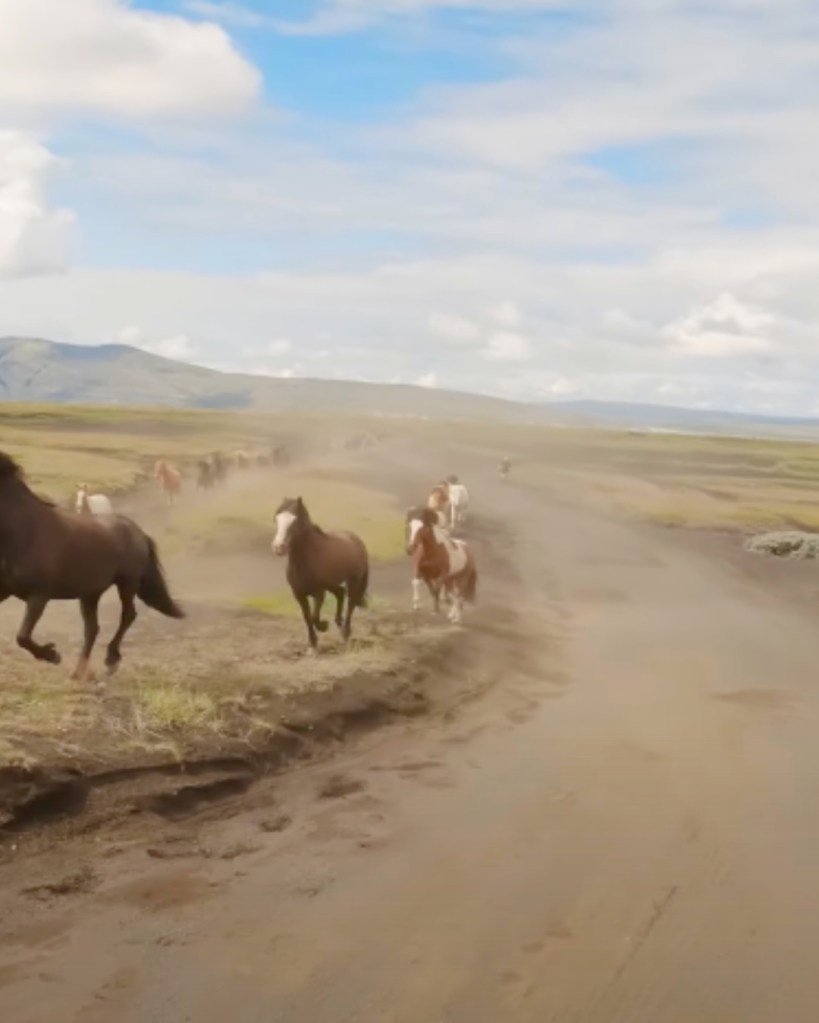
    The Rift is not your average gravel bike race. It covers a distance of 200 kilometres through the rugged terrain of Iceland, including lava fields, glaciers, and volcanic landscapes. There is a pretty cool portion where you ride down a snow covered Volcano. Riders must navigate gravel roads, Uber cold river crossings, and challenging climbs, some you can only go up by walking. All that, and much more unpredictable events and weather making the Rift a true test of skill and endurance. In 2022, a pack of wild horses ran beside the riders in a valley… it was spectacular.

    My friend Max crossing a river during the 2022 edition.
    The same river crossing a few minutes later. Heavy rain and high winds quickly replaced the sunny weather.
    My friend Charles got this shot while riding.

    In a matter of a few minutes, you can be riding under a sunny sky, shortly followed by a sudden and heavy rain fall or Hail, strong winds which of course will always be against you. The first 100km are going up. Not by much, as the total elevation is 2165m but most of the climbing is within the first half. Let’s just say that after 180km, the final remaining inclines hurt. A lot.

    More about the terrain and the course later.

    How can you prepare for The Rift?

    Well, that comes down to preparation. I’d sum this up like this: There are different aspects you need to prepare to succesfully complete The Rift. To tackle The Rift without suffering too much, you must be in a close to top physical condition. Additionally, you must have the right gear. Finally, you must manage your food intake regardless of the weather conditions.

    1- Training

    Training for long-distance gravel riding is something you should consider hiring a coach for. At least consider it. I know that modern cycling trends are pushing cyclist to ride longer and longer than ever. But still, 200km of road biking and 200km of gravel in Iceland is quite different.

    2- Bike and Gear preparation

    Obviously, if you travel all the way to Iceland with your bike to participate in a potentially once in a lifetime event, you must make sure your bike is in top condition. Duh.

    The Bike Stuff

    On top of having a bike in perfect condition, you must get familiar with how your bike works, what kind of parts are on it and have a minimal knowledge of how to fix it. Honestly, this is something The Rift organization does not mention enough in their Race guide.

    The Rift is a long event, you will be in the middle of nowhere, with little to no cellular coverage. You must be ready to fix almost anything on your bike, on your own. So learning how to fix a flat tire, repair a broken chain, install a tube in a torn tubeless tire, quickly bend back a disc, align your stem/handlebar assembly are just a few of the mechanical operations you should know how to do. You might have to perform any of these under conditions that are not the best. Imagine having to fiddle with a chain tool with frozen hands in windy and snowy conditions… I really do not want to scare anyone, but better be prepared than not.

    River crossing is pretty fun, but it can also mean the end of your ride if you crash on the derailleur side and break drivetrain components.

    In 2022, my first and only participation, I repaired 3 punctures (not even mine) and fixed a ben rim with a can opener and a volcanic rock. I had Tubeless sealant all over my gloves and rode 80km with a tubeless insert around my back. I helped a pro rider who had 8 punctures and needed a new wheel (I don’t know how he got a new wheel to finish his event). I mean… come one dude. That guy was not ready. Make sure your bike is in good condition and ready for a 200km gravel ride.

    Then, you must prepare your spare parts and repair kit. In essence, I strongly recommend that you pack these things, add more if you need more, but these would be the essentials:

    -Spare Derailleur Hanger
    -Chain breaker
    -Quick link
    -Multi-tool
    -Some sort of tubeless Repair kit (plugs and tire patch)
    -Mini-pump and Co2 cartridges.
    -Ultra-light spare tubes. The new Pirelli tubes are great. Super light, very compact. Worth the very expensive price.
    -Spare valve core
    -Small knive

    Once you got your repair kit ready, practice repairing stuff on your bike with it. It will be worth it.

    The riding Gear

    Finding the right clothes to wear for an event where about every type of weather conditions are expected is a challenge.

    If you are like me, IE not an outdoor, trekking, camping and mountaineering specialist, you will need to find the right gear to be comfortable and ready for anything. Which means understanding rainproof materials, merino wool, and find the best clothing you can for the budget you have. One great thing about The Rift is that they allow you to pack a small bag, which most people refer to as the ”sock bag”, that they will bring up to the 3rd feed (at 100km). Prior to the start, you can drop your bag, containing whatever you filled it with, in a huge truck. Unless you plan on winning the race as a Pro or in your age category, I’d strongly recommend taking advantage of this.

    The 100km feed (3rd) where you can grab your spare socks bag.
    Long sleeve skinsuits are excellent for the Rift.

    Typically, you would put in there a pair of warm socks (perhaps the ones the organization provides with each entry), spare gloves, maybe some food and a dry Buff. If you left with too much stuff, you can drop it in the bag and recuperate it at the end of the event. Whatever you think you need, put it in there. Better pack that bag with loads of stuff you won’t use than regret not packing it later. You could even cram a spare tube in there just in case.

    Because the weather changes so much, your clothes must allow you to ride comfortably in all those conditions. You will cross many rivers, walk up steep hills, run in loose snow and much more. So there is little you can do against all that. Compromise is key, I guess.

    Here are the clothing accessories that I think are essential:

    -Super light packable Gore-Tex-ish jacket.
    -Well padded long finger gloves
    -Super light short sleeve vest
    -Long socks of any type
    -Good Gravel/mountain bike shoes
    -Breathable Base layer
    -Photochromic lenses
    -Gravel/adventure style bib shorts (for their side pockets)

    Be ready for anything and everything. My Gore rain jacket perfectly fits in my toptube bag, making it easy for me to grab it and put it on while riding.
    3- Nutrition

    Again, a no brainer. To make your way through 200km of gravel cycling, you will need a considerable amount of fuel. One thing the organization has dialled in are feed zones. Man, there is all you can think of at each and every feed station. The thing is, it’s mainly junk food. I am not saying it’s bad, but think of the feed zones as a safety feature if ever you packed less food than necessary.

    Nothing is worst than hitting a wall at 120km knowing you still have 80 to go… (remember that last hill you must climb near the end I was talking about earlier?)

    So part of your training before the event will consist of finding the right food for that kind of distance and time spent on the bike. Can you tolerate it well? Is it easy to digest? Is it home made or pre-made? How do you eat it while riding? Where do you store it? etc.

    And the other thing to consider is that the food you are used to eat and train with might not be the food you need in this type of weather.

    My advice is, try to eat ”real food” as much as you can and keep the gels and bars and energy chews to top off your energy needs.

    And train using the bars, gels and other similar food you plan to use for the event.

    Circling back to the 100km feed and ”sock bag” truck: this feed station will also have Sandwiches of many different types. Which came as a huge relief for me.

    I am by no means a Nutrition expert but if you want to plan ahead, there are common food intake guidelines and formulas you can use. Those can easily be found online, but search for trustworthy sources and consult a certified Dietician/Nutritionist if you are in doubt. After all, incorrect food intake can lead to dangerous health issues. Don’t neglect that.

    End of part 1

    In the next part, I’ll present you with more gear for your bike and for yourself. I’ll talk more about the course itself as well.

    Almost there! The last banner seconds before you cross the finish line.
  • The Lezyne Pressure Overdrive Pump

    The Lezyne Pressure Overdrive Pump

    A pump designed for tubeless tires installation.
    Lezyne Pressure Overdrive floor pump.

    The struggle to install tubeless tires are home might be over. Especially if you have limited room and no space for a small air compressor. Introducing the Pressure Overdrive pump from Lezyne. A floor pump with an air canister attached to it that supposely can help you seat any tubeless tire. I have been testing this floor pump for the last 6 months and here are some thoughts.

    The Lezyne Pressure Overdrive floor pump is a big floor pump and thanks to its air canister and foot activated release valve; it’s ideal for seating tubeless tires at home and on the go.

    The secondary chamber (the canister) can be pumped up to store air under pressure. This air can then be used to seat a tubeless tire. If the tire was properly installed and centered over the rim, this sudden blast of air can easily seat the tire bead of any road, gravel and most mtb tires.

    I did a video review on my youtube channel about this Pump. I’ll link it a bit later in the article.

    Some cool specs

    The Pressure Overdrive boasts some cool features that are inline with Lezyne’s innovative nature.

    It’s got a huge gauge. It sits at the top of the pump so not only is it easy to read, but it’s also less prone to get damaged and collect dust.

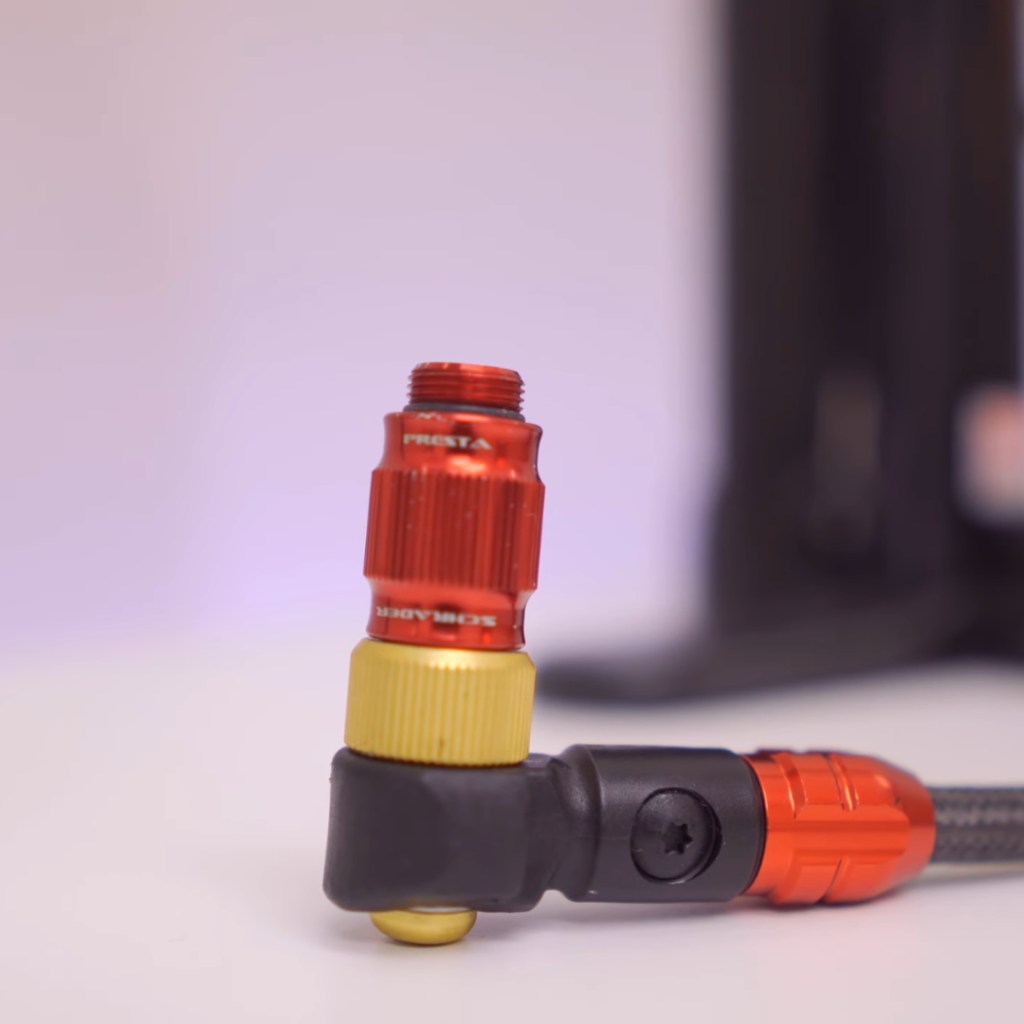
    The (infamous) Lezyne air chuck also has an incorporated valve core remover. Quick tip: if you remove the valve core before trying to seat your tubeless tire, you will greatly improve your chances of succeeding.

    the Lezyne ABS-1 pro chuck
    the ABS-1 pro chuck can also be used as a valve core remover.

    Most of the small parts are available from Lezyne or their distributors, so you can replace the chuck, the hose, the gauge, etc. Even the wooden handle is available.

    It can inflate tires up to 200psi.

    How it works

    It works just like a regular pump, but keep in mind that you should always keep some air in the canister, even if you don’t plan on installing tubeless tires. If there is no air in the canister, the air contained in the tire will flow in the canister. That means more pumping.

    Once you operate the foot lever, the air in the canister will flow in the tube/tire/tubular (or the other way around if there is more pressure in the thing you are trying to inflate) until the pressure in both is equal. Only then it is possible to inflate to the desired value.

    Before disconnecting the hose, make sure you close the canister valve. Otherwise, you will lose all that hard gained pressured air. (It happened to me a lot, and it sucks.)

    Does it work as promised?

    Yes! Especially if you remove the valve core first. And there are more ifs:

    Make sure the tire is well installed

    Make sure the rim tape is in good condition

    Get as much air as you can in the canister. Don’t think 80psi will be enough, it won’t.

    Once you open the valve, the air will quickly rush out of the canister. Make sure you can help the tire seat, or ask a friend to help you if you have one of these super supple tires. (Like a Rene Herse extralight).

    Is it a good everyday floor pump ?

    Not really. First of all: It’s slow. Although the actuation is very smooth, and it’s easy to get high pressures out of it, the volume it displaces is quite low. If you are in a rush before a race or at the shop, I would not be using that pump.

    Then, keep in mind that a lot of people just can’t manage the Lezyne ABS chuck, so you will either have to help them inflate their tire or replace it when they break it. I’ve been dealing with that chuck since it launched and I can tell that it’s not a popular feature.

    Luckily, Lezyne also makes a more traditionnal chuck, the Dual Valve Pump Head, that can be installed on any of their pumps.

    The pros

    It works for what it was designed for. Sounds obvious right? Well not all air canisters work and not all of them have the built quality of the Lezyne.

    The huge quantity of spare parts available for this pump means that your investment will last and you will be able to maintain it over time.

    It can also inflate track tubulars. Yeah, at the opposite of the tire technology spectrum, you will find tubulars. A stitched closed tire casing with an inner tube stuck inside, sometimes made of latex.

    Thanks to a gauge that goes up to 200psi, and because the pump is actually easy to operate, even at high pressures, this pump can become your track day pump. Incidently, a Silca 90degre pipe fits the ABS chuck threads perfeftly.

    It’s built to last. The Pressure Overdrive, like most Lezyne products, is made of quality materials, more often then not machined alloy and steel. High grade plastics are used for smaller parts.

    The cons

    It’s bulky and not well suited for travel or weekend rides. So you’ll need a second pump to throw in your car or the keep next to the door when you just want to add a wee bit of air.

    The ABS chuck is a well designed product. I personnaly dont mind it, but I know it’s not made for everyone. It can lead people to get so angry at their pump… believe me. There is a lot of tightening and untightening involved in inflating a tube or tire with a Lezyne pump. Plus, I’ve seen countless amounts of valve cores behind removed by accident by unexperimented Lezyne pump users.

    Get the Dual Valve head and be happy. 🙂

    Let’s talk about the price

    At 149$us, 199$cad, the Pressure Overdrive pump is not cheap. Heck it’s the price of a small air compressor.

    But the built quality is up there. The many functionnalities and characteristics are worth the price. Plus it’s a non-disposable product: spare parts are available and easy to find. If you care about keeping your stuff for a long time and reduce your consomption of products that end in the bin, any product made by Lezyne is made for you.

    Is it for you?

    If you enjoy doing your own mechanical work, and you have to deal with multiple tubeless wheelsets, this could be for you.

    Especially if you have limited space. Perhaps, like many, you live in a small appartment or far from a bike shop.

    If you only have one bike, and don’t care about tubeless installation, this is probably not for you. There are better floor pumps for general usage. Also keep in mind that dealing with tubeless tires, sealant, rim tape installation and worned out valves can be frustrating and exhausting. Sometimes it’s just better to bring your stuff to your local bike shop and have them do the work, with better tooling and more ressources.

    Verdict

    As a ex professional mechanic, dealing with many tubeless wheelsets, the Pressure Overdrive pump is the best home mechanic pump I could hope for. It’s also, I must say, the minimum I would go for considering the high volume of bikes I have to maintain. Anything less than what the Lezyne Pressure Overdrive has to offer would simply not cut it.

    During the 6 months I used this pump, I also came to the realization that I am probably going to need a small good quality air compressor.

    Video review
    About the testing and review:

    I purchased the Pressure Overdrive pump with my own money. Although Lezyne sent me many products to review over time, they did not have access to this review before posting it. My review and opinions are solely based on my experience with the product.

  • The smoothest ride since tubulars – Vittoria Corsa Pro

    The smoothest ride since tubulars – Vittoria Corsa Pro

    The new Vittoria Corsa Pro might be the best tire out there.

    I was actively looking for new tires that would allow me to ride till the end of the 2023 road season. I recently had small issues with my Pirelli tires, who are affected by a recall.

    As it often happens at the end of the summer, shops and distributors have very little in stock. And I was not going to settle for some third tier tire as I knew these would probably stay on my bike until late next season.

    So of course, I went out looking for a pair of Continental GP 5000 TR, in 700×28. And no luck: it’s out of stock. Everywhere!

    I was maybe going to consider a pair of 700×30 but then I saw a nice box with the Vittoria logo on it. A quick web research about the new Corsa pro confirms what most of the experts predicted when that tire made its first appearance on Jumbo-Visma Bikes. They are supposed to be fast, comfortable and reliable.

    The last set of GP 5000 (clinchers) I had were… boring. Efficient? Sure. Comfortable? not really. Did they feel fast? Not so much either. I know they are great tires. But I was looking for tires for my casual ride bike. The bike I take out when I ride with friends, on fast group rides or the casual ones. I wanted tires that would make my bike feel great! Not just be the most efficient and fast.

    Of course, I had Vittoria tires in the past. And honestly, I was never impressed. The so called ride quality of the open tubular tire never really convinced me. The first generation of open corsa, way back mid 2000’s, was fun to ride for maybe 200km until you started getting punctures after punctures. Then, I probably tried each iteration of those tires, either through sponsorship or by curiosity. And my opinion never really changed.

    So I was holding the box in my hand, thinking of my history with those tires and I was not sure I was ready to take a 200$ gamble. But reading about the new tire construction, and after getting some feedback from friends, I decided to show up at my local bike shop’s cash register and spend my money.

    Before Talking about the ride quality, I have to mention a few things.

    The packaging.

    Some of you may know, I criticize packaging a lot. For many reasons, but I generally judge packaging on those elements:

    • Is it somewhat ecological / eco friendly?
    • Is it easy to merchandise/market in store?
    • Does the packaging display all the important features of the product?

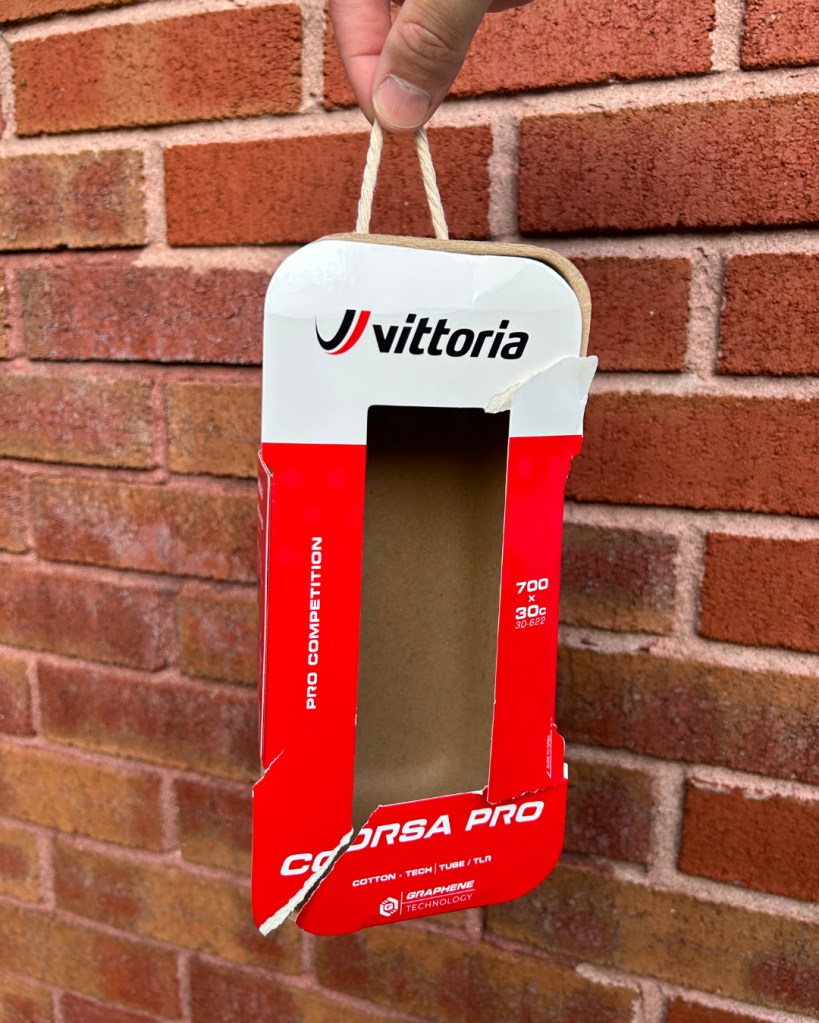
    Vittoria FINALLY moved away from those terrible Hexagonal shaped boxes, that kept opening from the bottom, quickly becoming a nightmare for bike shops to market on their sales floor. Those boxes were a small step in the right direction; ditching the previous plastic sleeves used to wrap the tires.

    Anyway: the new box is great! And here is why:

    • It’s made of recycled materials and is recyclable again. (depending on the facilities in your area, the packaging is even compostable.)
    • Displays all the pertinent info about the tire and even more!
    • It’s got a nice little handle so shops can easily hang it on their walls.

    I was so excited to get the tires out of the box that I forgot to take a picture of the Unopened box.

    Technical information

    One thing that tire manufacturer are trying to do is to come up with some sort of Tubeless standard, even more so since a lot of wheel manufacturers have implemented (for better or worse) the hookless rim technology into their lineup of products.

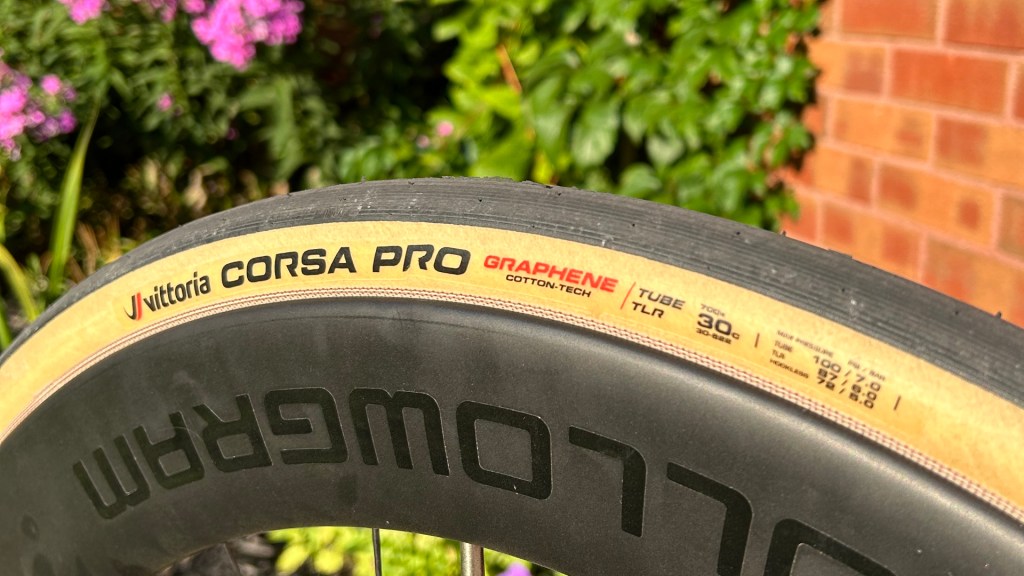
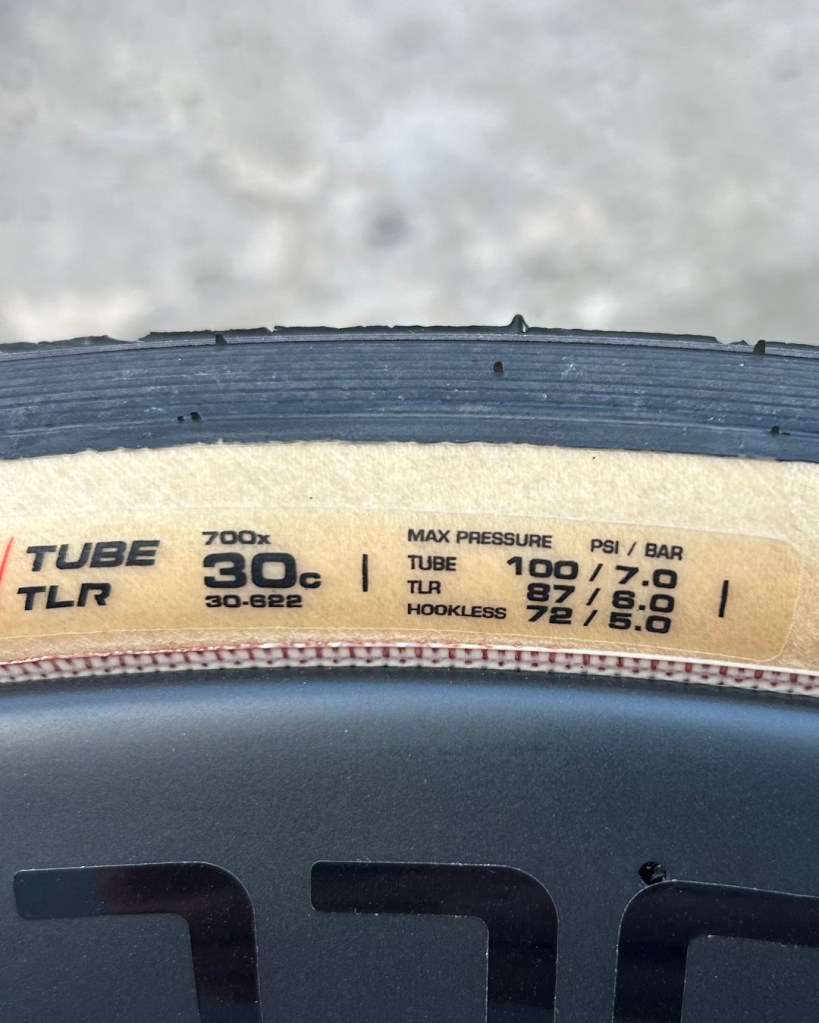
    Well, Vittoria did their homework and are displaying a lot of technical info on the box and the tire itself. You can now easily determine how safe it is to ride this tire depending on the rim you own and potentially avoid all the possible nightmares caused by the road tubeless technology.

    In my case, I knew that the ETRTO specification of 700×30 on 21mm width rims was perfect for my Hollogram wheels. Plus, Vittoria clearly indicates the maximum tire pressure recommended depending on your wheel setup, which makes it easier for anyone to inflate their tires safely.

    You don’t have to read the fine prints: All the info is clearly displayed.
    Technology made its way on tires… imagine that!
    Tire Technology

    Of course these tires benefit from all the latest technology Vittoria has to offer.

    If you are into buzz words, you can look up all their spiel on Graphene (from which comes their obsession with the hexagonal shape) and Silica compound.

    The ride

    Alright! here we are.

    Until I get punctures after punctures, and cuts in the sidewall of this tire (if ever); I will say this:

    This is the most satisfying road bike tire you can ride, right now, on the market.

    Here’s why:

    • It feels absolutely fast (even the bulkier 700×30)
    • It is very comfortable and supple. ( keep in mind I am riding tubes for now)
    • I suspect this tire would be even more fun, supple and comfortable in a tubeless setup.
    • It has a similar grip feel than the GP 5000.
    • It feels light, fast, comfortable. (Yes! I am repeating myself)

    A few things to consider before purchasing:

    • There is only 1 sidewall color. It does not fit well with my bike. But it is what it is.
    • The price. This is definitely a high end tire with a premium feel.
    • Some might say it is hard to install. I personnaly thought it was in the ”easy to medium” range of how hard a tire can be to install.
    • Be sure to never use Amonia based Sealant if you are planning on riding Tubeless.

    Verdict:

    Possibly the best road bike tire on the market right now.

    I rode this tire for… 200km. Yup, that’s it. And it was enough to convince me.

    And I can tell you this: on a nice sunny, warm day, this is the best road bike tire I ever rode. It feels spectacular. It’s not dull, neutral, boring. It has some flair and it makes you feel great on the bike.

    What I also mean is that I have not yet had the chance to test the tires in wet conditions and I doubt I would even report on that in the future as riding in the rain is generally a ”mid” experience and tire performance is definitely not the first thing I have in mind. (unless I get a puncture of course)

    If you are looking for amazing, high end, high performance tires for next season, go to your local bike shop now and pre-order them. Keep in mind to verify with your wheels/rim manufacturer if the tires are compatible with them especially if you have hookless rims.

    * I purchased thee tires with my money, from my local bike shop and my opinion is based on my riding experience alone.

  • Tubeless madness

    Tubeless madness

    Should you ride Tubeless tires on your bike?

    Tubeless tire technology was rapidly adopted by mountain bikers in the mid 2000’s. Oddly enough, Road tubeless tires have been around since the mid 2000’s as well but still have not been adopted by most riders. For a technology that has been around for so long, it is quite surprising to see that there is still no real consensus on what should be the ”norm” for road tubeless tires.

    They first ever tubeless wheels I rode were the Shimano Dura Ace (WH-7850-C24-TL) wheels with Hutchinson Fusion tires. Back then, there was no sealant used and it was said that the most popular sealant then, made from Stan’s, was corroding the rims. I went on riding 2000km with that wheelset and tires with no issues, not even a puncture and on top of that, the whole setup was easy, effortless and safe.

    So why is it that in 2023, we have about as many tubeless rim standards as there are seatpost sizes and so little confidence in the technology? How can tire companies make some of the most efficient tires in terms of rolling resistance but not endorse a wheel design or brand while some others just develop their own tires to match their rims.

    Unfortunately I do not have answers to any of these questions. All I have is experience riding many, many different setups, tires and rims brands.

    Tubeless is (finally) getting some traction.

    One thing is for sure, riding tubeless tires is a consideration a lot more people have, especially since there was a road cycling boom a few years ago. Now everyone can find (good or bad) advice on social media, internet, youtube and blogs, about any cycling technology. Needless to say all those multiple sources can create a turmoil of clashing and contradicting informations.

    I think this is another reason why companies, wether they manufacture rims, tires, valves or inserts, should sit down and come up with some sort of standard. I liked the Mavic Tubeless standard, called UST. It was simple, reliable and safe. But modern bikes, with modern wheels, getting wider and wider caused the death of UST road. Enve is working to create a standard, but will other brands jump in that boat? who knows…

    So, should you ride hookless rims vs hooked rims, tubeless vs tubes, what sealant type, inserts or not?

    It depends. Of course.

    If you don’t want to bother with sealant and keep the possibility of swapping tires easily without spending too much; i’d say keep riding tubes.

    If you only have one set of wheel/tires, and the rims are Tubeless ready, and the valves were included with the wheels and the rims have hooks: I’d say try tubeless tires. No more pinch flats, easy to set-up, more comfort, a bit more grip if needed and a relatively simple tire set-up for you or your local bike shop.

    If you are an experienced cyclist, looking for the latest innovation on the market, you feel comfortable with messing around bike maintenance or have a great local bike shop, you are the perfect candidate for riding hookless tubeless tires.

    the Zipp 404 Firecrest wheel has a hookless rim.

    Hookless rims are often a bit harder to setup, they, most of the time, require specific tires to match the rim and they are a nightmare to deal with when you have a puncture and the sealant does not do its job. Some hookless rims can’t even be used with a tube, so you are stuck riding tubeless.

    Now if you heard horror stories from your friends or online, about tubeless tires exploding while trying to set them up, most of the time, those stories involve hookless rims, tires that have not been ”approved” to work with a certain rim, or the person had little experience installing a tubeless tire.

    How to avoid Tubeless failures

    Here is a short list of advice:

    • Follow instructions
    • Don’t try to do a tubeless conversion the day before your ride
    • Don’t race new stuff
    • Pick a reliable, known setup over exotic stuff
    • whatever you do, safety first.

    Think about the people riding around you and their safety. Not just yours. No one wants to crash and get injured because you cut corners while working on your bike.

    The Muc-Off Tubeless Setup kit has everything you need for your first tubeless conversion kit.

    Tubeless made easy

    So if you are looking for specific advice on what products to use, I’ve got you covered. I have installed about every types of tires you can think of. Some good, some bad and some that were impossible to setup Tubeless. When I am stuck with a rim or a tire that does not want to seat properly, that shows signs of exploding off the rim while inflating or that leaks air and sealant and can’t be fixed, I always revert to this: Grab any Pirelli Tubeless compatible tire and it will work.

    For real. You might go through the usual tubeless struggle, but I have never failed to install a Pirelli tire on any rim regardless of the brand, type, width, shape or material. They might not show as the fastest tires when comparing with other brands, but they will work. And this is where reliability stomps speed. A reliable setup will always be somehow fast, at least much faster than spending 40 minutes on the side of the road with your hands painted with pink, orange or smelly sealant, a tire around your neck and a bunch of dudes that are only thinking of leaving you there and get back home.

    I am not saying other brands are not good. I am saying if you want a good first experience installing tubeless tires, pick a Pirelli tire, for you road or gravel bike.

    Pirelli cycling tires are the easiest tires to install when going tubeless.

    My tubeless setups

    I do have a wheelset that has Continental gravel tires installed. They are good tires. But they sure are not easy to install. I also have a set with Rene Herse tires, which are fantastic to ride, but a nightmare to install and I got 3 wheelsets with Pirelli tires. Again, installing those was easy. You can see the installation videos on my instagram and youtube page.

    Instragram @andreas_ihm