Tag: road tubeless

  • The Lezyne Pressure Overdrive Pump

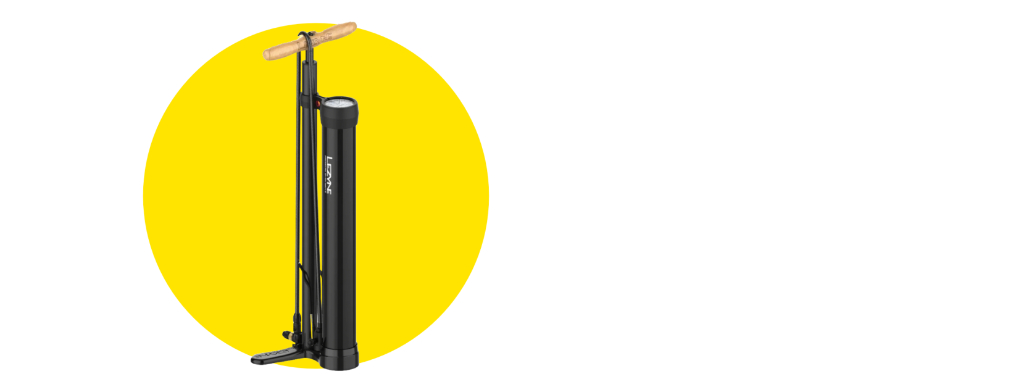
    The Lezyne Pressure Overdrive Pump

    A pump designed for tubeless tires installation.
    Lezyne Pressure Overdrive floor pump.

    The struggle to install tubeless tires are home might be over. Especially if you have limited room and no space for a small air compressor. Introducing the Pressure Overdrive pump from Lezyne. A floor pump with an air canister attached to it that supposely can help you seat any tubeless tire. I have been testing this floor pump for the last 6 months and here are some thoughts.

    The Lezyne Pressure Overdrive floor pump is a big floor pump and thanks to its air canister and foot activated release valve; it’s ideal for seating tubeless tires at home and on the go.

    The secondary chamber (the canister) can be pumped up to store air under pressure. This air can then be used to seat a tubeless tire. If the tire was properly installed and centered over the rim, this sudden blast of air can easily seat the tire bead of any road, gravel and most mtb tires.

    I did a video review on my youtube channel about this Pump. I’ll link it a bit later in the article.

    Some cool specs

    The Pressure Overdrive boasts some cool features that are inline with Lezyne’s innovative nature.

    It’s got a huge gauge. It sits at the top of the pump so not only is it easy to read, but it’s also less prone to get damaged and collect dust.

    The (infamous) Lezyne air chuck also has an incorporated valve core remover. Quick tip: if you remove the valve core before trying to seat your tubeless tire, you will greatly improve your chances of succeeding.
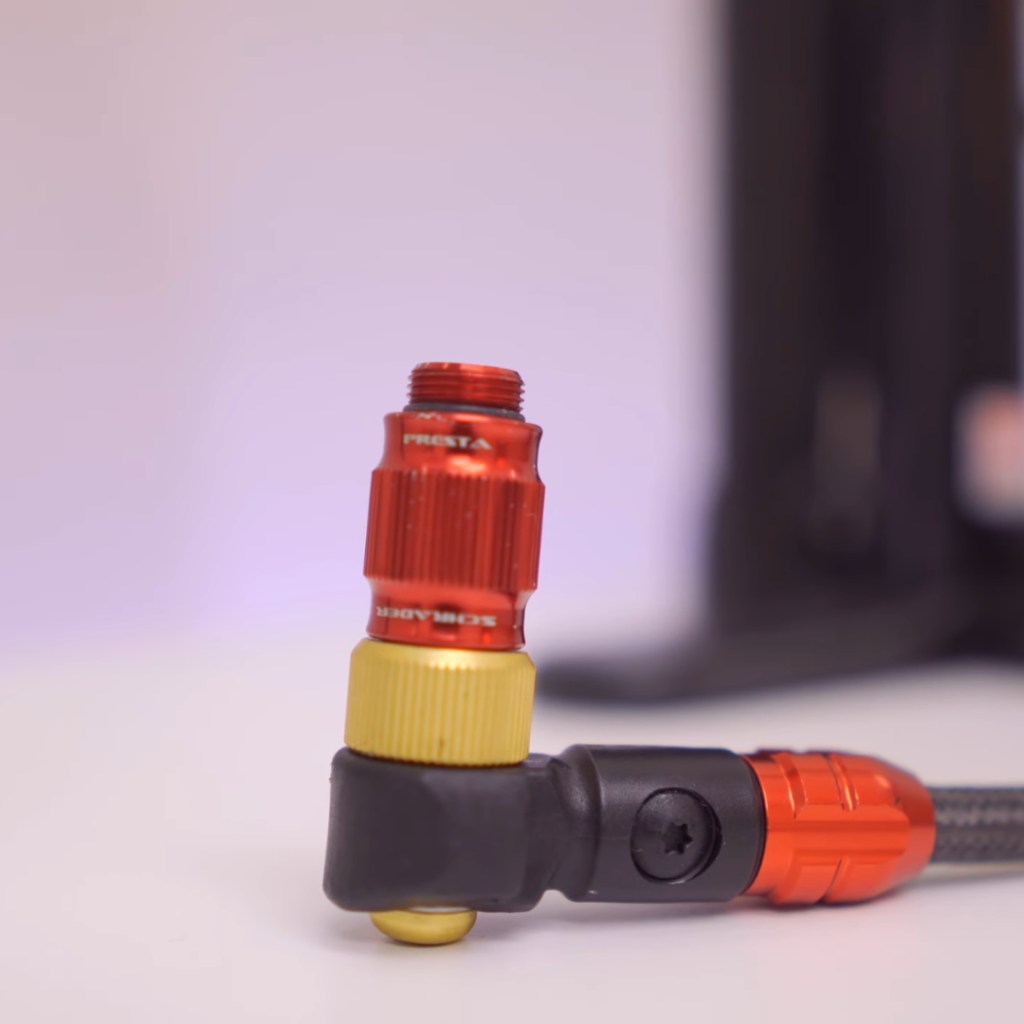
    the Lezyne ABS-1 pro chuck
    the ABS-1 pro chuck can also be used as a valve core remover.

    Most of the small parts are available from Lezyne or their distributors, so you can replace the chuck, the hose, the gauge, etc. Even the wooden handle is available.

    It can inflate tires up to 200psi.

    How it works

    It works just like a regular pump, but keep in mind that you should always keep some air in the canister, even if you don’t plan on installing tubeless tires. If there is no air in the canister, the air contained in the tire will flow in the canister. That means more pumping.

    Once you operate the foot lever, the air in the canister will flow in the tube/tire/tubular (or the other way around if there is more pressure in the thing you are trying to inflate) until the pressure in both is equal. Only then it is possible to inflate to the desired value.

    Before disconnecting the hose, make sure you close the canister valve. Otherwise, you will lose all that hard gained pressured air. (It happened to me a lot, and it sucks.)

    Does it work as promised?

    Yes! Especially if you remove the valve core first. And there are more ifs:

    Make sure the tire is well installed

    Make sure the rim tape is in good condition

    Get as much air as you can in the canister. Don’t think 80psi will be enough, it won’t.

    Once you open the valve, the air will quickly rush out of the canister. Make sure you can help the tire seat, or ask a friend to help you if you have one of these super supple tires. (Like a Rene Herse extralight).

    Is it a good everyday floor pump ?

    Not really. First of all: It’s slow. Although the actuation is very smooth, and it’s easy to get high pressures out of it, the volume it displaces is quite low. If you are in a rush before a race or at the shop, I would not be using that pump.

    Then, keep in mind that a lot of people just can’t manage the Lezyne ABS chuck, so you will either have to help them inflate their tire or replace it when they break it. I’ve been dealing with that chuck since it launched and I can tell that it’s not a popular feature.

    Luckily, Lezyne also makes a more traditionnal chuck, the Dual Valve Pump Head, that can be installed on any of their pumps.

    The pros

    It works for what it was designed for. Sounds obvious right? Well not all air canisters work and not all of them have the built quality of the Lezyne.

    The huge quantity of spare parts available for this pump means that your investment will last and you will be able to maintain it over time.

    It can also inflate track tubulars. Yeah, at the opposite of the tire technology spectrum, you will find tubulars. A stitched closed tire casing with an inner tube stuck inside, sometimes made of latex.

    Thanks to a gauge that goes up to 200psi, and because the pump is actually easy to operate, even at high pressures, this pump can become your track day pump. Incidently, a Silca 90degre pipe fits the ABS chuck threads perfeftly.

    It’s built to last. The Pressure Overdrive, like most Lezyne products, is made of quality materials, more often then not machined alloy and steel. High grade plastics are used for smaller parts.

    The cons

    It’s bulky and not well suited for travel or weekend rides. So you’ll need a second pump to throw in your car or the keep next to the door when you just want to add a wee bit of air.

    The ABS chuck is a well designed product. I personnaly dont mind it, but I know it’s not made for everyone. It can lead people to get so angry at their pump… believe me. There is a lot of tightening and untightening involved in inflating a tube or tire with a Lezyne pump. Plus, I’ve seen countless amounts of valve cores behind removed by accident by unexperimented Lezyne pump users.

    Get the Dual Valve head and be happy. 🙂

    Let’s talk about the price

    At 149$us, 199$cad, the Pressure Overdrive pump is not cheap. Heck it’s the price of a small air compressor.

    But the built quality is up there. The many functionnalities and characteristics are worth the price. Plus it’s a non-disposable product: spare parts are available and easy to find. If you care about keeping your stuff for a long time and reduce your consomption of products that end in the bin, any product made by Lezyne is made for you.

    Is it for you?

    If you enjoy doing your own mechanical work, and you have to deal with multiple tubeless wheelsets, this could be for you.

    Especially if you have limited space. Perhaps, like many, you live in a small appartment or far from a bike shop.

    If you only have one bike, and don’t care about tubeless installation, this is probably not for you. There are better floor pumps for general usage. Also keep in mind that dealing with tubeless tires, sealant, rim tape installation and worned out valves can be frustrating and exhausting. Sometimes it’s just better to bring your stuff to your local bike shop and have them do the work, with better tooling and more ressources.

    Verdict

    As a ex professional mechanic, dealing with many tubeless wheelsets, the Pressure Overdrive pump is the best home mechanic pump I could hope for. It’s also, I must say, the minimum I would go for considering the high volume of bikes I have to maintain. Anything less than what the Lezyne Pressure Overdrive has to offer would simply not cut it.

    During the 6 months I used this pump, I also came to the realization that I am probably going to need a small good quality air compressor.

    Video review
    About the testing and review:

    I purchased the Pressure Overdrive pump with my own money. Although Lezyne sent me many products to review over time, they did not have access to this review before posting it. My review and opinions are solely based on my experience with the product.
  • The smoothest ride since tubulars – Vittoria Corsa Pro

    The smoothest ride since tubulars – Vittoria Corsa Pro

    The new Vittoria Corsa Pro might be the best tire out there.

    I was actively looking for new tires that would allow me to ride till the end of the 2023 road season. I recently had small issues with my Pirelli tires, who are affected by a recall.

    As it often happens at the end of the summer, shops and distributors have very little in stock. And I was not going to settle for some third tier tire as I knew these would probably stay on my bike until late next season.

    So of course, I went out looking for a pair of Continental GP 5000 TR, in 700×28. And no luck: it’s out of stock. Everywhere!

    I was maybe going to consider a pair of 700×30 but then I saw a nice box with the Vittoria logo on it. A quick web research about the new Corsa pro confirms what most of the experts predicted when that tire made its first appearance on Jumbo-Visma Bikes. They are supposed to be fast, comfortable and reliable.

    The last set of GP 5000 (clinchers) I had were… boring. Efficient? Sure. Comfortable? not really. Did they feel fast? Not so much either. I know they are great tires. But I was looking for tires for my casual ride bike. The bike I take out when I ride with friends, on fast group rides or the casual ones. I wanted tires that would make my bike feel great! Not just be the most efficient and fast.

    Of course, I had Vittoria tires in the past. And honestly, I was never impressed. The so called ride quality of the open tubular tire never really convinced me. The first generation of open corsa, way back mid 2000’s, was fun to ride for maybe 200km until you started getting punctures after punctures. Then, I probably tried each iteration of those tires, either through sponsorship or by curiosity. And my opinion never really changed.

    So I was holding the box in my hand, thinking of my history with those tires and I was not sure I was ready to take a 200$ gamble. But reading about the new tire construction, and after getting some feedback from friends, I decided to show up at my local bike shop’s cash register and spend my money.

    Before Talking about the ride quality, I have to mention a few things.

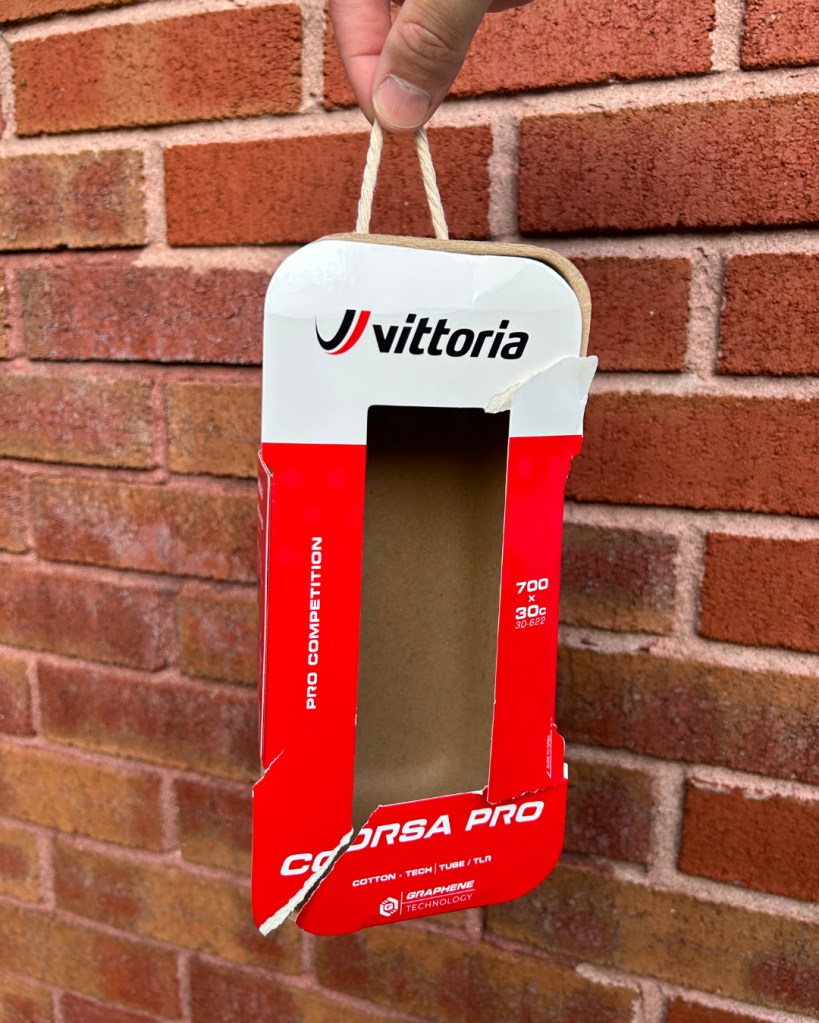
    The packaging.

    Some of you may know, I criticize packaging a lot. For many reasons, but I generally judge packaging on those elements:

    • Is it somewhat ecological / eco friendly?
    • Is it easy to merchandise/market in store?
    • Does the packaging display all the important features of the product?

    Vittoria FINALLY moved away from those terrible Hexagonal shaped boxes, that kept opening from the bottom, quickly becoming a nightmare for bike shops to market on their sales floor. Those boxes were a small step in the right direction; ditching the previous plastic sleeves used to wrap the tires.

    Anyway: the new box is great! And here is why:

    • It’s made of recycled materials and is recyclable again. (depending on the facilities in your area, the packaging is even compostable.)
    • Displays all the pertinent info about the tire and even more!
    • It’s got a nice little handle so shops can easily hang it on their walls.

    I was so excited to get the tires out of the box that I forgot to take a picture of the Unopened box.

    Technical information

    One thing that tire manufacturer are trying to do is to come up with some sort of Tubeless standard, even more so since a lot of wheel manufacturers have implemented (for better or worse) the hookless rim technology into their lineup of products.

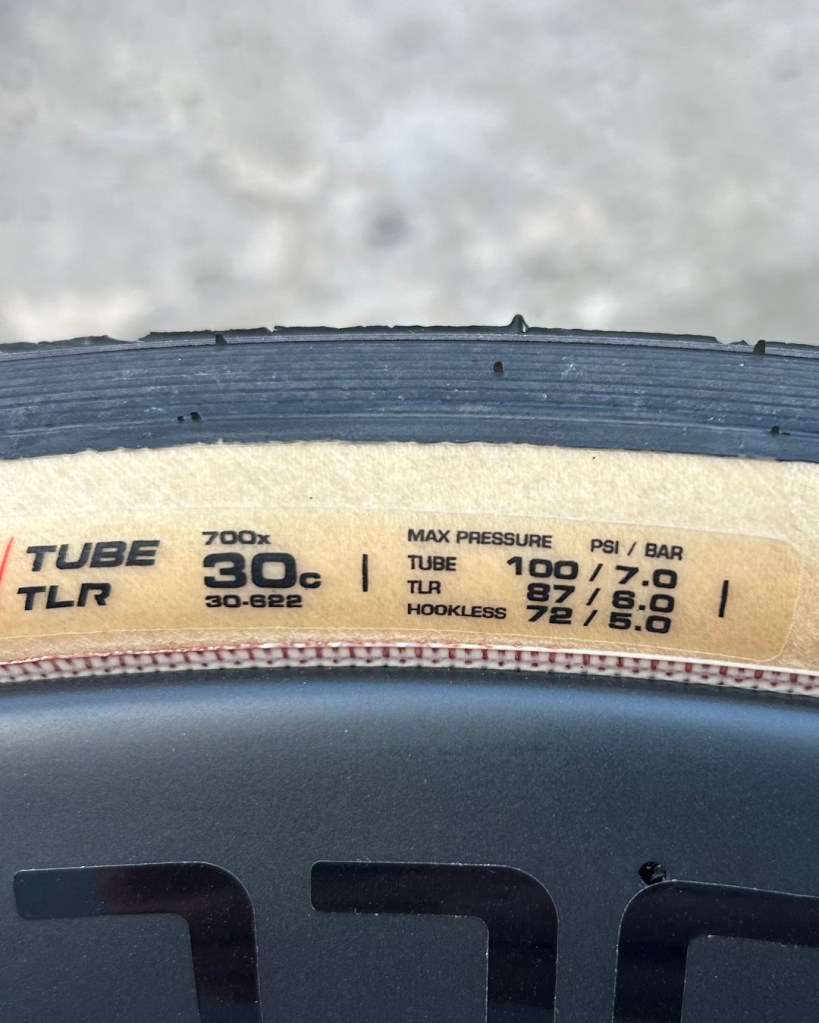
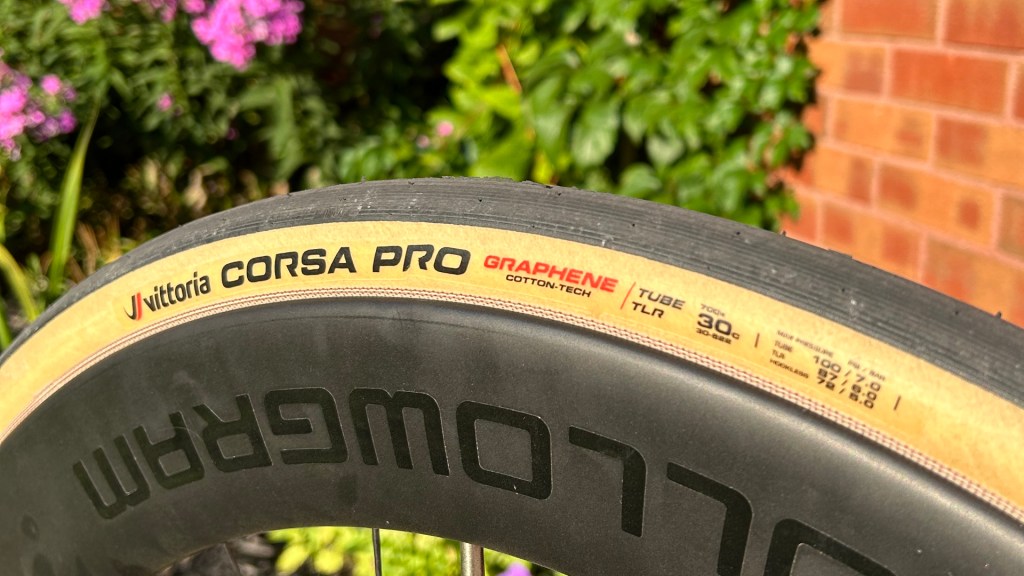
    Well, Vittoria did their homework and are displaying a lot of technical info on the box and the tire itself. You can now easily determine how safe it is to ride this tire depending on the rim you own and potentially avoid all the possible nightmares caused by the road tubeless technology.

    In my case, I knew that the ETRTO specification of 700×30 on 21mm width rims was perfect for my Hollogram wheels. Plus, Vittoria clearly indicates the maximum tire pressure recommended depending on your wheel setup, which makes it easier for anyone to inflate their tires safely.

    You don’t have to read the fine prints: All the info is clearly displayed.
    Technology made its way on tires… imagine that!
    Tire Technology

    Of course these tires benefit from all the latest technology Vittoria has to offer.

    If you are into buzz words, you can look up all their spiel on Graphene (from which comes their obsession with the hexagonal shape) and Silica compound.

    The ride

    Alright! here we are.

    Until I get punctures after punctures, and cuts in the sidewall of this tire (if ever); I will say this:

    This is the most satisfying road bike tire you can ride, right now, on the market.

    Here’s why:

    • It feels absolutely fast (even the bulkier 700×30)
    • It is very comfortable and supple. ( keep in mind I am riding tubes for now)
    • I suspect this tire would be even more fun, supple and comfortable in a tubeless setup.
    • It has a similar grip feel than the GP 5000.
    • It feels light, fast, comfortable. (Yes! I am repeating myself)

    A few things to consider before purchasing:

    • There is only 1 sidewall color. It does not fit well with my bike. But it is what it is.
    • The price. This is definitely a high end tire with a premium feel.
    • Some might say it is hard to install. I personnaly thought it was in the ”easy to medium” range of how hard a tire can be to install.
    • Be sure to never use Amonia based Sealant if you are planning on riding Tubeless.

    Verdict:

    Possibly the best road bike tire on the market right now.

    I rode this tire for… 200km. Yup, that’s it. And it was enough to convince me.

    And I can tell you this: on a nice sunny, warm day, this is the best road bike tire I ever rode. It feels spectacular. It’s not dull, neutral, boring. It has some flair and it makes you feel great on the bike.

    What I also mean is that I have not yet had the chance to test the tires in wet conditions and I doubt I would even report on that in the future as riding in the rain is generally a ”mid” experience and tire performance is definitely not the first thing I have in mind. (unless I get a puncture of course)

    If you are looking for amazing, high end, high performance tires for next season, go to your local bike shop now and pre-order them. Keep in mind to verify with your wheels/rim manufacturer if the tires are compatible with them especially if you have hookless rims.

    * I purchased thee tires with my money, from my local bike shop and my opinion is based on my riding experience alone.

  • Tubeless madness

    Tubeless madness

    Should you ride Tubeless tires on your bike?

    Tubeless tire technology was rapidly adopted by mountain bikers in the mid 2000’s. Oddly enough, Road tubeless tires have been around since the mid 2000’s as well but still have not been adopted by most riders. For a technology that has been around for so long, it is quite surprising to see that there is still no real consensus on what should be the ”norm” for road tubeless tires.

    They first ever tubeless wheels I rode were the Shimano Dura Ace (WH-7850-C24-TL) wheels with Hutchinson Fusion tires. Back then, there was no sealant used and it was said that the most popular sealant then, made from Stan’s, was corroding the rims. I went on riding 2000km with that wheelset and tires with no issues, not even a puncture and on top of that, the whole setup was easy, effortless and safe.

    So why is it that in 2023, we have about as many tubeless rim standards as there are seatpost sizes and so little confidence in the technology? How can tire companies make some of the most efficient tires in terms of rolling resistance but not endorse a wheel design or brand while some others just develop their own tires to match their rims.

    Unfortunately I do not have answers to any of these questions. All I have is experience riding many, many different setups, tires and rims brands.

    Tubeless is (finally) getting some traction.

    One thing is for sure, riding tubeless tires is a consideration a lot more people have, especially since there was a road cycling boom a few years ago. Now everyone can find (good or bad) advice on social media, internet, youtube and blogs, about any cycling technology. Needless to say all those multiple sources can create a turmoil of clashing and contradicting informations.

    I think this is another reason why companies, wether they manufacture rims, tires, valves or inserts, should sit down and come up with some sort of standard. I liked the Mavic Tubeless standard, called UST. It was simple, reliable and safe. But modern bikes, with modern wheels, getting wider and wider caused the death of UST road. Enve is working to create a standard, but will other brands jump in that boat? who knows…

    So, should you ride hookless rims vs hooked rims, tubeless vs tubes, what sealant type, inserts or not?

    It depends. Of course.

    If you don’t want to bother with sealant and keep the possibility of swapping tires easily without spending too much; i’d say keep riding tubes.

    If you only have one set of wheel/tires, and the rims are Tubeless ready, and the valves were included with the wheels and the rims have hooks: I’d say try tubeless tires. No more pinch flats, easy to set-up, more comfort, a bit more grip if needed and a relatively simple tire set-up for you or your local bike shop.

    If you are an experienced cyclist, looking for the latest innovation on the market, you feel comfortable with messing around bike maintenance or have a great local bike shop, you are the perfect candidate for riding hookless tubeless tires.

    the Zipp 404 Firecrest wheel has a hookless rim.

    Hookless rims are often a bit harder to setup, they, most of the time, require specific tires to match the rim and they are a nightmare to deal with when you have a puncture and the sealant does not do its job. Some hookless rims can’t even be used with a tube, so you are stuck riding tubeless.

    Now if you heard horror stories from your friends or online, about tubeless tires exploding while trying to set them up, most of the time, those stories involve hookless rims, tires that have not been ”approved” to work with a certain rim, or the person had little experience installing a tubeless tire.

    How to avoid Tubeless failures

    Here is a short list of advice:

    • Follow instructions
    • Don’t try to do a tubeless conversion the day before your ride
    • Don’t race new stuff
    • Pick a reliable, known setup over exotic stuff
    • whatever you do, safety first.

    Think about the people riding around you and their safety. Not just yours. No one wants to crash and get injured because you cut corners while working on your bike.

    The Muc-Off Tubeless Setup kit has everything you need for your first tubeless conversion kit.

    Tubeless made easy

    So if you are looking for specific advice on what products to use, I’ve got you covered. I have installed about every types of tires you can think of. Some good, some bad and some that were impossible to setup Tubeless. When I am stuck with a rim or a tire that does not want to seat properly, that shows signs of exploding off the rim while inflating or that leaks air and sealant and can’t be fixed, I always revert to this: Grab any Pirelli Tubeless compatible tire and it will work.

    For real. You might go through the usual tubeless struggle, but I have never failed to install a Pirelli tire on any rim regardless of the brand, type, width, shape or material. They might not show as the fastest tires when comparing with other brands, but they will work. And this is where reliability stomps speed. A reliable setup will always be somehow fast, at least much faster than spending 40 minutes on the side of the road with your hands painted with pink, orange or smelly sealant, a tire around your neck and a bunch of dudes that are only thinking of leaving you there and get back home.

    I am not saying other brands are not good. I am saying if you want a good first experience installing tubeless tires, pick a Pirelli tire, for you road or gravel bike.

    Pirelli cycling tires are the easiest tires to install when going tubeless.

    My tubeless setups

    I do have a wheelset that has Continental gravel tires installed. They are good tires. But they sure are not easy to install. I also have a set with Rene Herse tires, which are fantastic to ride, but a nightmare to install and I got 3 wheelsets with Pirelli tires. Again, installing those was easy. You can see the installation videos on my instagram and youtube page.

    Instragram @andreas_ihm