
What is Bonking?
Not eating and drinking (good) enough. Dangers and prevention.
You know that friend that always drops off the ride because he’s hungry. Or that friend who’s black cycling jersey turns white because he’s loses a lot of salt? Well send them this article, because we are going to cover those subjects.
The Bonk
Generally, Bonking arrives when an athlete does not fuel enough during a prolonged activity.
Meaning, they’ve completely depleted their reserve of Glycogen without replenishing it during the activity.
This can be quite dangerous and lead to unwanted results, ranging from going back home in a taxi to going to the hospital in an ambulance.
No need to panic here, an extreme Bonk is rare and hopefully you will notice the signs before.
Some people will refer the normal form of bonking as ”hitting the wall”. A friend of mine says he’s made it to Bonkcity. However you want to call it, here are signs you are bonking:
- General feeling of fatigue, not just in the legs.
- Feeling flat, energy less.
- Craving food, sugar, salt, ( when fast food is the first thing that comes to your mind…).
Getting out of that Bonked state can be possible. But do not expect a quick 5 minute break to be enough. You will need food, rest and probably a nature break.
Prevent the Bonk
The main role of carbohydrates is to provide energy to muscles and some vital organs. Meaning, not managing that during any sport activity or competition will most probably lead to your downfall.
It’s a tough ordeal to find the right combination of food, drinks and energy output management to prevent the Bonk.
Many articles will state that you must manage your food/carbs consumption to be anywhere between 30gr to 90gr of carbs per hour.
You can decide to do so with only food, or a mix of food and sports drinks. One of the main difficulty is to find a balance between any type of food or drink you are using for training or for a competition. Basically, you need to test and discover, most of the time through a long trial and error method, what product works best for you.
Not only will you start reading nutritional facts for sport specific food, but you will most probably start doing so for day to day food and drinks.
If there is only one thing to remember from this whole article, it would be this: before any competition, make sure you test the product you want to use during said competition. Just like with new components, gear, apparel, etc.: never race new $h!t.
Once you’ve found the food, bars, gels, energy blocks etc. that work for you and that don’t upset your stomach, you can start calculating how much of it you need to eat during any activity.
You should also calculate the nutritional values of whatever sport drink you are planning on using. And if you were planning on running on water, think again. Let’s talk about it right now.
*Important disclaimer: I am not a nutritionist, dietician or medical expert. In most countries, those professions are governed by a professional order that makes sure the public gets protected. In all good faith, I am simply trying to offer my perspective and my experience with sports nutrition.
If you feel like you need more information, you can dive in and google articles and reviews about sports nutrition at will. Or consult a professional.
Why drinking water isn’t enough for endurance sports and long distance cycling.
Hyponatraemia
Hyponatraemia happens when the amount of sodium in your blood is too low. In endurance sports, it can be caused by excessive hydration. This loss of salt, or sodium deficiency, can cause your body to shut down and it extreme cases, it can cause brain swelling, confusion, seizures, or even death.
How it happens:
- Drinking water far more than you need
- Sweat a lot resulting in high sodium loss.
- Unawarely diluting your body’s salt levels too much
Serious symptoms that can result from Hyponatraemia
- General body discomfort
- Vomiting
- Headaches and confusion
- Coma
The Role of Electrolytes in Sports Performance
Electrolytes are minerals in your body that carry an electric charge and are crucial for:
- Efficient muscle function by replacing lost electrolytes during activity like: sodium, potassium, magnesium, and calcium.
- Neuro-muscular efficiency.
- Hyponatraemia prevention. (Sodium and potassium help regulate the amount of water inside and outside your blood cells.)
- Preventing cramping and fatigue. (Low electrolyte levels can lead to muscle cramps and general body weakness)
Most hydration powders can compensate electrolytes loss.
Hyponatraemia prevention
Most articles about sport nutrition and hydration will state that a minimum of one liter of water per hour is required to insure proper hydration.
Now that we know that drinking only plain water is not good, let’s add the recommended dose of electrolytes to our water bottles.
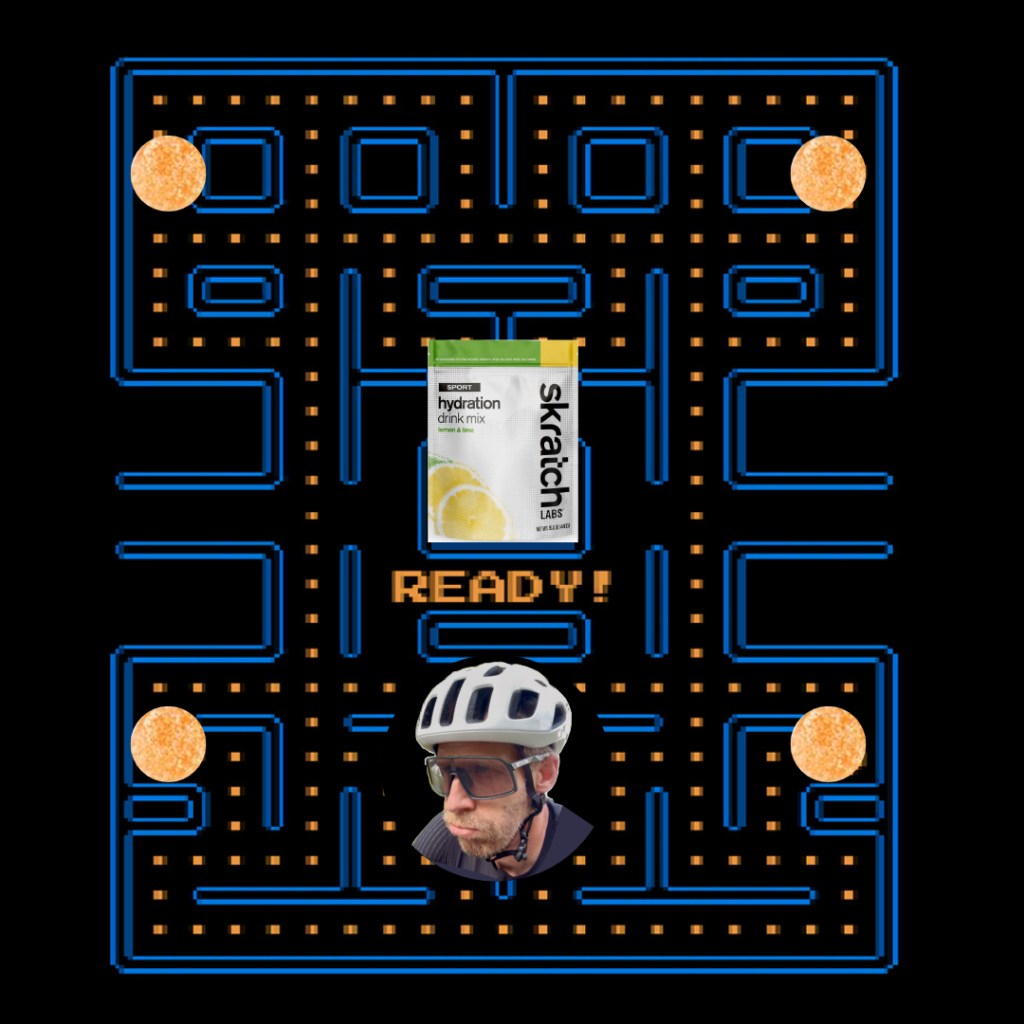
As an example, I use Skratch Hydration mix. Skratch recommends 1 scoop of 22gr of powder per 450/500ml of water.
The result in terms of energy intake is:
| Calories | 80 |
| Fat | 0 |
| Carbohydrate | 20g |
| Protein | 0 |
| Sodium | 400mg |
| Potassium | 50mg |
| Calcium | 50mg |
| Magnesium | 50mg |
| vitamin C | 18mg |

Just randomly drinking water with Electrolytes isn’t enough to maintain sodium levels. Make sure you keep in mind that.
- Drink regularly, don’t wait to be thirsty.
- Set timed alerts for food and hydration on your Cycling Computer.
- Include salt in your food intake like Soups or salty snacks.
- Avoid salt capsules as some studies doubt they are effective for prevention and can be risky.
Essentially, during any activity that goes over an hour, or in hot conditions, only drinking plain water can increase the risk of Hyponatremia. Adding electrolytes to your water reduces that risk.
What about energy gels?
Energy gels primarily provide quick carbohydrates for fuel during prolonged exercise. Some gels also contain electrolytes, but their main role is to:
- Maintain blood glucose levels.
- Prevent early fatigue or even compensate for late fatigue (some gels have caffeine).
- Provide quick and easily digestible energy.
Gels can help you with keeping a good energy level through your activity or provide sudden energy needs, while electrolyte drinks helps hydration beyond what water can provide.
Of course, a lot or people use both in combination, plus a regular intake of carbs.
Nutrition Strategy
Before copying an existing nutrition strategy that someone told you about, make sure that you have tested the ingredients before. try alternatives that match your tastes and budget.
In my case, here is part of my nutrition strategy. It sometimes vary depending on weather, my physical condition and availability of products.
For my Electrolytes needs, my go to is the Skratch Hydration Powder.
I find it easy on the stomach and easy to drink. I have never had difficulty diluting it in water even when trying double-dosage.
They offer many flavours, but I stick to Lemon + Lime.
- any ride: I mix 1 serving cup with 550ml of water + 550ml of water in another bidon.
- Long endurace rides:
- I mix 1 serving cup with 550ml of water
- I mix 1 serving cup with 700ml of water and I add maple syrup for more carbs.
- I’ll eat 1 energy chew every 20 minutes for a total of 100 calories and 24gr of carbs over an hour.
Here is what I would consider to be my hourly intake on a long distance bike ride or event.
| Skratch Hydration 22gr | Skratch energy chews 10gr | Maple Syrup Mix 60ml + 22gr Skratch Hydration | |
| Calories | 80 | 32 | 220 |
| Carbs | 20gr | 7,6gr | 54gr |
| Sodium | 400mg | 18mg | 0mg |
| Potassium | 50mg | 4mg | 200mg |
Keep in mind that any hydration mix of electrolytes is not a one stop shop for your energy source. It has a specific purpose but you need to eat on top of that. I rarely use energy gels but I’ll have real food and energy blocks so I can maintain some sort of performance.
The main objective of a balanced nutrition stragegy is to prevent Bonking and hyponatremia at the same time.
What about Gatorade and similar drinks?
That is a good question. the only answer I have for you is: if it works for you, go ahead and use those products.
In my case, I can’t drink half a bottle without feeling bloated and it considerably affects my performance in a negative way. I suddenly feel heavy, bloated, and it takes hours for my body to return to normal. I don’t know what in the composition of those beverages makes me feel that way. I wish I could tell you more.
It’s no-go for me. But I am not saying this is not a viable alternative.
Please do your own research about these products.
A Banana?
Many cyclists carry a banana with them. When 3D printing started, people made all sorts of Banana carrying devices.
Is a Banana really good for endurance cycling? What are the pros and cons?
With about 27gr of Carbohydrate per fruit; the Banana can be a good source of energy. With high levels of Potassium, it can help replace some electrolytes lost in sweat.
Is it most and foremost a natural alternative. It can sometimes complement gels by adding variety to your diet and reduce processed sugar intake.
Most athletes find it easy to digest, but timing consumption is a must to avoid possible gastro intestinal discomfort.
The main drawback of the Banana is finding a way to transport it.

Here is a comparison table showing Skratch electrolyte powder, Gatorade Gatorlyte , Energy gels and a Banana
| 1 scoop of Skratch Hydration Powder (in 500ml of water) | Gatorade Gatorlyte (591ml) | Energy Gel (32gr) | 1 Banana | |
| Why use it? | Hydration & electrolyte replacement | Hydration & electrolyte replacement | Rapid carbohydrate | it’s good food |
| Calories | 80 | 50 | 100 | 105 |
| Does it have electrolytes? | Sodium: 400mg Potassium 50mg, Magnesium 50mg Calcium 50mg | Sodium: 490mg Potassium: 350mg Magnesium: 105mg Calcium: 120mg | Sodium: 60mg Calcium: 30mg | Potassium: 422mg |
| Carbohydrate | 20gr | 14gr | 21gr | 27gr |
| Ideal for | Serious training and competition | Back-up solution | Quick energy intake | Real food intake |
Planning a Nutrition Strategy is for you if
If you are an avid endurance athlete or enthusiast, you need to consider a sport specific food and drink intake. At least while you are doing your activity. It could prevent immediate and delayed health issues while also potentially help you achieve better performances.
Every year, when I am out on bike tours and bike rides I meet athletes that hit the wall. And I wish I could have shared some knowledge with them prior to seeing them crumbling on the side of the road, 40km away from the hotel or home.
If bonking is not something you experience ever, perhaps you found a strategy that works for you. Be a sport: Grab a few extra gels or bar and keep them handy to help your fellow (Bonked) Cyclist.
Looking for Skratch Products in Canada?
You can order them directly from TRACKLOFT or find them at your local bike shop.



 Boards and Peaks - Von Westfalen