There is a lot of debate going on about what is the best gravel bike tire on the market right now.
In fact, most current gravel bike frames are now allowing for the use of narrow mountain bike tires because apparently, they’re faster.
With high profile events like Unbound and the Gravel Earth series making their course harder than ever, the search of the ideal gravel bike tire is one that seems forever ongoing.
No BS
But what if you are simply looking for a good, no non-sense quality gravel tire? One that offers a smooth ride, tubeless (ertro) compatibility and good performance on and off road?
Well let’s talk about the Vittoria Terreno Dry tire. Specifically the latest iteration, that offers a graphene 2.0 compound, soft sidewalls, compared to the previous and the first generation.
The new Vittoria Terreno Dry
Fun fact, at the moment of writing this, MVDP just won the Gravel World Championships using this very tire.
So, although there is a debate about how “easy” that course was, it still very much ressembles to what most of us ride casually on weekends. And that type of course kinda dictates what tire you want to use.
Tire specs:
The Terreno Dry’s Graphene-infused compound is said to be more durable, faster, and lighter than rubber alone. (I am unsure when is the last time a company made a tire with a full rubber compound). The Terreno dry is reinforced with a durable, supple Lite nylon casing and an additional layer of puncture protection on the center strip. The now old but still “revolutionary” fish scale tread pattern is smooth on gravel straights and bites quite well when cornering and braking.
Possible configurations
700×40 or 700×47, however, I have never seen the 700×47 out there.
It’s a good tire. There is nothing wrong about the Terreno tire. It is often used as a OEM tire by bike manufacturer. It’s reliable, confidence inspiring, works on gravel really well.
Tubeless installation is super easy! The new Vittoria packaging is worth mentioning, as the finally dropped the hexagonal shaped boxes.
Tan walls are pretty on this tire if it’s the look you are going for.
Downsides?
It’s painfully slow on the road. It’s not the fastest on the gravel either. There are so many variations of this specific tire, and generations of that tire, that it is quite hard to find an exact replacement. Luckily, Vittoria recently announced a complete revamp of their Gravel Bike Tire Lineup with a name and nomenclature change. A welcomed change that will also affect any interest for this generation of the Terreno.
Do I recommend?
Yes if you are looking for an easy to install, reliable, no BS gravel tire, and they have it in stock as a pair at your local bike shop at a good price. Longevity of the tires seems also pretty good.
They are not the best, not the worst. If they come already installed on your bike, ride them!
I do not have a rating system yet for anything, but that would be a 3.49726374 stars out of 5.
Not eating and drinking (good) enough. Dangers and prevention.
You know that friend that always drops off the ride because he’s hungry. Or that friend who’s black cycling jersey turns white because he’s loses a lot of salt? Well send them this article, because we are going to cover those subjects.
The Bonk
Generally, Bonking arrives when an athlete does not fuel enough during a prolonged activity. Meaning, they’ve completely depleted their reserve of Glycogen without replenishing it during the activity. This can be quite dangerous and lead to unwanted results, ranging from going back home in a taxi to going to the hospital in an ambulance.
No need to panic here, an extreme Bonk is rare and hopefully you will notice the signs before.
Some people will refer the normal form of bonking as ”hitting the wall”. A friend of mine says he’s made it to Bonkcity. However you want to call it, here are signs you are bonking:
General feeling of fatigue, not just in the legs.
Feeling flat, energy less.
Craving food, sugar, salt, ( when fast food is the first thing that comes to your mind…).
Getting out of that Bonked state can be possible. But do not expect a quick 5 minute break to be enough. You will need food, rest and probably a nature break.
Prevent the Bonk
The main role of carbohydrates is to provide energy to muscles and some vital organs. Meaning, not managing that during any sport activity or competition will most probably lead to your downfall.
It’s a tough ordeal to find the right combination of food, drinks and energy output management to prevent the Bonk.
Many articles will state that you must manage your food/carbs consumption to be anywhere between 30gr to 90gr of carbs per hour.
You can decide to do so with only food, or a mix of food and sports drinks. One of the main difficulty is to find a balance between any type of food or drink you are using for training or for a competition. Basically, you need to test and discover, most of the time through a long trial and error method, what product works best for you.
Not only will you start reading nutritional facts for sport specific food, but you will most probably start doing so for day to day food and drinks.
If there is only one thing to remember from this whole article, it would be this: before any competition, make sure you test the product you want to use during said competition. Just like with new components, gear, apparel, etc.: never race new $h!t.
Once you’ve found the food, bars, gels, energy blocks etc. that work for you and that don’t upset your stomach, you can start calculating how much of it you need to eat during any activity.
You should also calculate the nutritional values of whatever sport drink you are planning on using. And if you were planning on running on water, think again. Let’s talk about it right now.
*Important disclaimer: I am not a nutritionist, dietician or medical expert. In most countries, those professions are governed by a professional order that makes sure the public gets protected. In all good faith, I am simply trying to offer my perspective and my experience with sports nutrition.
If you feel like you need more information, you can dive in and google articles and reviews about sports nutrition at will. Or consult a professional.
Why drinking water isn’t enough for endurance sports and long distance cycling.
Hyponatraemia
Hyponatraemia happens when the amount of sodium in your blood is too low. In endurance sports, it can be caused by excessive hydration. This loss of salt, or sodium deficiency, can cause your body to shut down and it extreme cases, it can cause brain swelling, confusion, seizures, or even death.
How it happens:
Drinking water far more than you need
Sweat a lot resulting in high sodium loss.
Unawarely diluting your body’s salt levels too much
Serious symptoms that can result from Hyponatraemia
General body discomfort
Vomiting
Headaches and confusion
Coma
The Role of Electrolytes in Sports Performance
Electrolytes are minerals in your body that carry an electric charge and are crucial for:
Efficient muscle function by replacing lost electrolytes during activity like: sodium, potassium, magnesium, and calcium.
Neuro-muscular efficiency.
Hyponatraemia prevention. (Sodium and potassium help regulate the amount of water inside and outside your blood cells.)
Preventing cramping and fatigue. (Low electrolyte levels can lead to muscle cramps and general body weakness)
Most hydration powders can compensate electrolytes loss.
Hyponatraemia prevention
Most articles about sport nutrition and hydration will state that a minimum of one liter of water per hour is required to insure proper hydration. Now that we know that drinking only plain water is not good, let’s add the recommended dose of electrolytes to our water bottles.
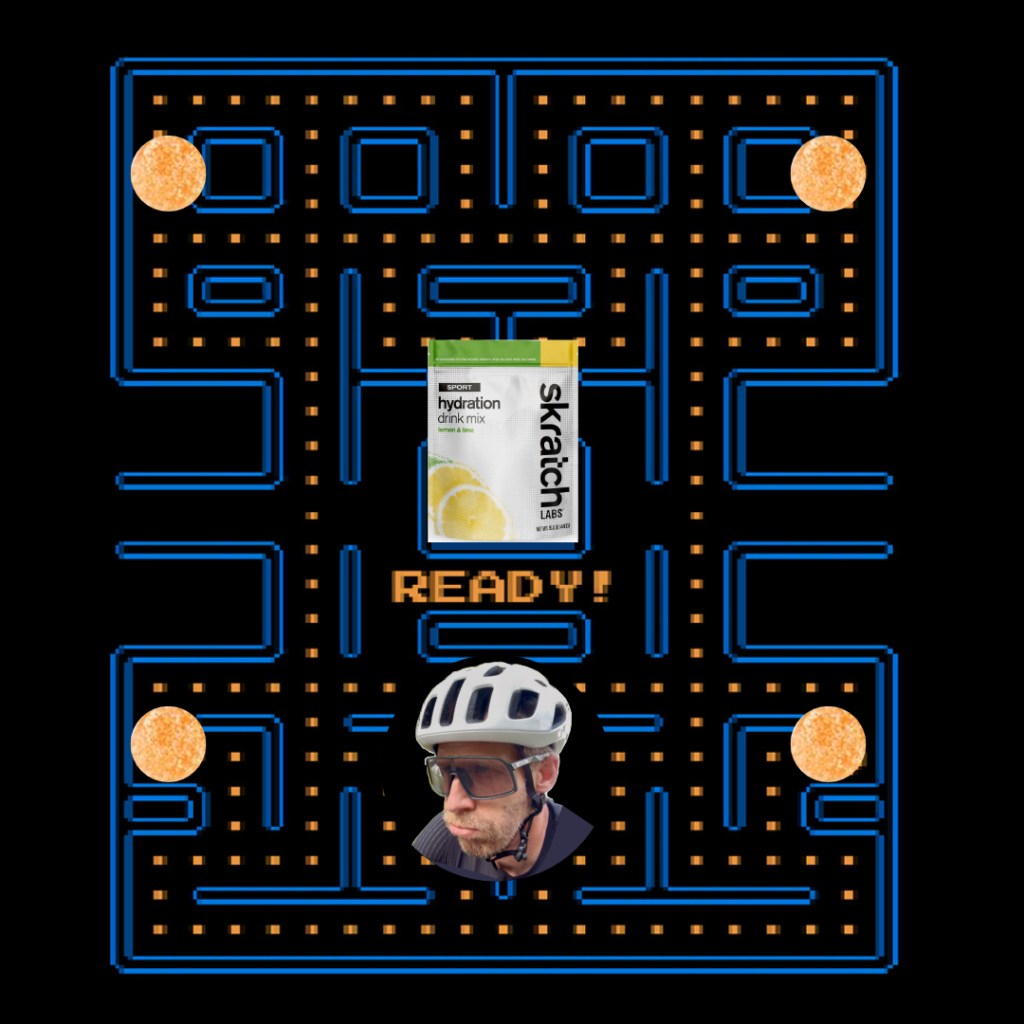
As an example, I use Skratch Hydration mix. Skratch recommends 1 scoop of 22gr of powder per 450/500ml of water.
The result in terms of energy intake is:
Calories
80
Fat
0
Carbohydrate
20g
Protein
0
Sodium
400mg
Potassium
50mg
Calcium
50mg
Magnesium
50mg
vitamin C
18mg
Just randomly drinking water with Electrolytes isn’t enough to maintain sodium levels. Make sure you keep in mind that.
Drink regularly, don’t wait to be thirsty.
Set timed alerts for food and hydration on your Cycling Computer.
Include salt in your food intake like Soups or salty snacks.
Avoid salt capsules as some studies doubt they are effective for prevention and can be risky.
Essentially, during any activity that goes over an hour, or in hot conditions, only drinking plain water can increase the risk of Hyponatremia. Adding electrolytes to your water reduces that risk.
What about energy gels?
Energy gels primarily provide quick carbohydrates for fuel during prolonged exercise. Some gels also contain electrolytes, but their main role is to:
Maintain blood glucose levels.
Prevent early fatigue or even compensate for late fatigue (some gels have caffeine).
Provide quick and easily digestible energy.
Gels can help you with keeping a good energy level through your activity or provide sudden energy needs, while electrolyte drinks helps hydration beyond what water can provide.
Of course, a lot or people use both in combination, plus a regular intake of carbs.
Nutrition Strategy
Before copying an existing nutrition strategy that someone told you about, make sure that you have tested the ingredients before. try alternatives that match your tastes and budget.
In my case, here is part of my nutrition strategy. It sometimes vary depending on weather, my physical condition and availability of products.
For my Electrolytes needs, my go to is the Skratch Hydration Powder.
I find it easy on the stomach and easy to drink. I have never had difficulty diluting it in water even when trying double-dosage.
They offer many flavours, but I stick to Lemon + Lime.
any ride: I mix 1 serving cup with 550ml of water + 550ml of water in another bidon.
Long endurace rides:
I mix 1 serving cup with 550ml of water
I mix 1 serving cup with 700ml of water and I add maple syrup for more carbs.
I’ll eat 1 energy chew every 20 minutes for a total of 100 calories and 24gr of carbs over an hour.
Here is what I would consider to be my hourly intake on a long distance bike ride or event.
Skratch Hydration 22gr
Skratch energy chews 10gr
Maple Syrup Mix 60ml + 22gr Skratch Hydration
Calories
80
32
220
Carbs
20gr
7,6gr
54gr
Sodium
400mg
18mg
0mg
Potassium
50mg
4mg
200mg
Keep in mind that any hydration mix of electrolytes is not a one stop shop for your energy source. It has a specific purpose but you need to eat on top of that. I rarely use energy gels but I’ll have real food and energy blocks so I can maintain some sort of performance.
The main objective of a balanced nutrition stragegy is to prevent Bonking and hyponatremia at the same time.
What about Gatorade and similar drinks?
That is a good question. the only answer I have for you is: if it works for you, go ahead and use those products.
In my case, I can’t drink half a bottle without feeling bloated and it considerably affects my performance in a negative way. I suddenly feel heavy, bloated, and it takes hours for my body to return to normal. I don’t know what in the composition of those beverages makes me feel that way. I wish I could tell you more.
It’s no-go for me. But I am not saying this is not a viable alternative.
Please do your own research about these products.
A Banana?
Many cyclists carry a banana with them. When 3D printing started, people made all sorts of Banana carrying devices. Is a Banana really good for endurance cycling? What are the pros and cons?
With about 27gr of Carbohydrate per fruit; the Banana can be a good source of energy. With high levels of Potassium, it can help replace some electrolytes lost in sweat.
Is it most and foremost a natural alternative. It can sometimes complement gels by adding variety to your diet and reduce processed sugar intake.
Most athletes find it easy to digest, but timing consumption is a must to avoid possible gastro intestinal discomfort.
The main drawback of the Banana is finding a way to transport it.
Here is a comparison table showing Skratch electrolyte powder, Gatorade Gatorlyte , Energy gels and a Banana
1 scoop of Skratch Hydration Powder (in 500ml of water)
If you are an avid endurance athlete or enthusiast, you need to consider a sport specific food and drink intake. At least while you are doing your activity. It could prevent immediate and delayed health issues while also potentially help you achieve better performances.
Every year, when I am out on bike tours and bike rides I meet athletes that hit the wall. And I wish I could have shared some knowledge with them prior to seeing them crumbling on the side of the road, 40km away from the hotel or home.
If bonking is not something you experience ever, perhaps you found a strategy that works for you. Be a sport: Grab a few extra gels or bar and keep them handy to help your fellow (Bonked) Cyclist.
Looking for Skratch Products in Canada?
You can order them directly from TRACKLOFT or find them at your local bike shop.
Trouver le bon pneu de gravel est un défi de taille. il y a tellement de choix, de paramètres, que cela peut devenir difficile de prendre une décision. On peut choisir un pneu selon plusieurs critères. La résistance au roulement en est un. On peut aussi choisir un pneu de gravelle en fonction de sa fiabilité, son poids, sa facilité d’installation, le confort, son profil de crampons, le style et la couleur.
Je me suis donc lancé dans ce projet ambitieux, afin de tester 3 modèles de pneus de gravel afin de déterminer lequel est le plus rapide, ou du moins, celui qui offre la moins grande résistance au roulement sur une surface de gravelle.
Il existe quelques tests similaires, la plupart fais en laboratoire mais je n’en ai pas trouvé qui ont été fait dehors et sans biais de commandites ou de lien affiliés.
Les pneus testés aujourd’hui:
Continental Terra Speed. 700×45
Vittoria Terreno Dry. 700×40
Panaracer GravelKing X1 2024. 700×45
J’ai choisi ces pneus pour les raisons suivantes: -Le Vittoria Terreno Dry est équipé de série sur plusieurs vélo, il est donc plutôt commun. -Le Terra Speed a toujours été très populaire depuis sont lancement et est maintenant offert en 700×45, ce que beaucoup attendaient avec impatience. Il a la réputation d’être le pneu cramponné le plus rapide sur le marché. -Le Gravel King de Panaracer est un des premiers pneus de gravel ”mainstream” et la nouvelle version méritait d’être testée. C’est un pneu souvent négligé, pour plusieurs raisons. On va voir si cette nouvelle version,le X1, deviendra populaire grâce à son nouveau design de crampons. Vous pourrez lire mes premières impressions dans un autre article bientôt.
Le test
Il a fallu un avant midi complet pour tester les 3 pneus (en paire évidemment). J’ai donc installé 3 paires de pneus dans le stationnement du parc Frédéric Back avec une pompe réservoir (la Lezyne Pressure Overdrive). C’était un peu sportif!
La pompe Pressure Overdrive de Lezyne
La gauge digitale Honest de Blackburn
Voici comment j’ai testé les 3 pneus.
Le montage a été fait sur la même paire de roues.
Largeur interne 27mm.
Jantes en carbone Hookless.
J’ai utilisé un insert dans chaque pneu.
Montage tubeless évidemment, avec 30ml de scellant dans chaque pneu.
J’ai ensuite fais une multitudes de boucles du parc, donc 5.35km par tour, en respectant les conditions suivantes:
Un premier tour à 25km/h avec 29psi dans chaque pneu.
Un deuxième tour à 30km/h avec 29psi dans chaque pneu.
Un troisième tour à 30km/h avec 26psi dans chaque pneu.
Le capteur de puissance a été fréquemment calibré.
Résultats
Continental Terra Speed
Le Continental Terra Speed porte bien son nom. J’ai eu du mal à respecter la vitesse de 25km/h que j’avais planifiée pour le premier test. Et je n’ai presque pas perçu la différence d’effort requis pour passer de 25km/h à 30km/h.
Comme c’était le premier test de la journée, supposons que j’avais de bonnes jambes.
C’est donc le nez collé à mon Garmin que j’ai fait mon premier test.
Le profil de crampons minimaliste.
Le Continental Terra Speed avec flancs beiges.
Voici les résultats:
25km/h à 29psi:
Moyenne: 25.84km/h
Moyenne: 156 watts
Moyenne normalisée: 195 watts
Temps: 12:35
Temps en position assise: 12:27
30km/h à 29psi:
Moyenne: 30.86km/h
Moyenne: 226 watts
Moyenne normalisée: 255 watts
Temps: 10:30
Temps en position assise: 10:16
30km/h à 26psi:
Moyenne: 30.91km/h
Moyenne: 226 watts
Moyenne normalisée: 255 watts
Temps: 10:30
Temps en position assise: 9:47
Malgré une bande de roulement aux apparences symétriques, le Continental Terra Speed est bel et bien directionnel.
Il faut donc l’installer dans le bon sens de rotation pour en tirer le maximum de performance et de rendement.
Conclusions
Le Continental Terra Speed est un pneu très rapide. En effet, selon le site tirerollingresistance.com; le Terra Speed en 700×45 est plus rapide qu’une multitude de pneus de route lisses, et ce malgré la présence de crampons.
Il faut avouer que la taille des crampons est plutôt petite. Et les crampons latéraux ne permettent qu’une faible accroche latérale. D’ailleurs, déception, le 700×45 mesure 43 sur mes jantes, qui font pourtant 27mm de largeur interne. Je suspecte que le pneu s’écrase, à basse pression, et adopte sa largeur réelle ainsi.
Par contre, la traction et l’adhérence peut être obtenue en réduisant la pression, ce qui permet au pneu de se déformer et de mieux épouser terrain. Il n’y a aucune pénalité à réduire la pression sur le Continental Terra Speed et c’est ainsi que vous en tirerez le maximum.
Qui sait si la résistance de roulement ne serait pas identique à une pression encore plus basse. À vous de tester!
Vittoria Terreno Dry
Le Vittoria Terreno Dry, présenté ici dans sa version 2.0, est un pneu relativement passe-partout et efficace. Un look sobre, un design de crampon hybride, avec accroche latérale cramponnée et une bande de roulement relativement lisse.
On remarque, visuellement, que la bande de roulement est relativement épaisse, ce qui met en confiance coté résistance aux crevaisons. Depuis que Vittoria a adopté le standard ETRTO, leur pneu sont devenus très facile à installer en montage Tubeless et sont très fiables.
Surprise, Le 700×40 mesurait 42 sur mes jantes. C’est aussi le seul pneu avec un profil relativement ”carré”, qui s’écrase à plat sur le terrain, comme un boyaux.
On remarque le design polyvalent du Terreno Dry.
Le Terreno Dry avec flancs beiges.
Voici le tableau des résultats.
25km/h à 29psi:
Moyenne: 25.89km/h
Moyenne: 163 watts
Moyenne normalisée: 189 watts
Temps: 12:16
Temps en position assise: 12:29
30km/h à 29psi:
Moyenne: 30.64km/h
Moyenne: 236 watts
Moyenne normalisée: 261 watts
Temps: 10:34
Temps en position assise: 10:25
30km/h à 26psi:
Moyenne: 30.58km/h
Moyenne: 243 watts
Moyenne normalisée: 266 watts
Temps: 10:31
Temps en position assise: 10:25
Le vittoria Terreno Dry est aussi un pneu qui a été conçu avec un sens de rotation. On peut facilement voir les crampons latéraux, qui donnent au pneu son caractère rassurant en virage.
Conclusion
Le Terreno Dry de Vittoria est un excellent pneu ”all-around” qui cependant, donne des résultats de résistance au roulement un peu plus élevés que le Terra Speed. C’est aussi le seul pneu dont la résistance au roulement augmente en réduisant la pression.
Par expérience, ce pneu est aussi très lent sur l’asphalte à une pression de 29psi ou moins. Malgré cela, c’est un pneu qui mets en confiance et qui est prévisible.
Compte tenu que les championnats du monde de gravel ont été remportés avec le Vittoria Terreno Dry, il serait intéressant de tester la résistance au roulement à des pressions plus élevées.
Panaracer Gravel King X1
Je découvre le Gravel King dans sa nouvelle mouture, qui apparemment est plus raffinée, plus rapide et qui propose un cramponnage amélioré. Le Gravel King est un classique devenu peu populaire car beaucoup de pneus plus modernes ont pris le marché d’assault et l’engouement pour ce pneu Japonais s’est estompé au fil du temps. La première version était aussi relativement capricieuse à l’installation et exigeait patience et détermination lorsqu’on voulait le monter Tubeless. De plus, le pneu avait la réputation de projeter les petits cailloux qui se coinçaient entre les crampons vers l’arrière, ce qui rendait l’expérience plutôt pénible pour les cyclistes autour.
Le design élaboré de crampons du X1
Une étiquette plutôt jolie. Fait au Japon.
Voici les résultats.
25km/h à 29psi:
Moyenne: 25.89km/h
Moyenne: 156 watts
Moyenne normalisée: 185 watts
Temps: 12:36
Temps en position assise: 12:00
30km/h à 29psi:
Moyenne: 30.43km/h
Moyenne: 227 watts
Moyenne normalisée: 255 watts
Temps: 10:32
Temps en position assise: 10:13
30km/h à 26psi:
Moyenne: 30.85km/h
Moyenne: 224 watts
Moyenne normalisée: 247 watts
Temps: 10:28
Temps en position assise: 10:06
La flèche qui indique le sens de rotation.
Le pneu Gravel King X1 est aussi directionnel. Malgré la taille minimaliste de la flèche, le design de crampon permet tout de même de facilement deviner le sens de rotation.
Le Gravel King X1 s’est avéré le pneu le plus difficile à installer.
Conclusion
Le nouveau Gravel King est un pneu surprenant! Confortable et prévisible, offrant une accroche latérale surprenante. Idéal pour ceux qui recherchent un pneu qui mets en confiance, particulièrement en virage sur gravelle douce.
En chiffres: ce pneu, comme le Terra Speed, s’est avéré un peu plus rapide à plus basse pression. La sensation à plus basse pression était excellente. On peut sentir le pneu se déformer et mordre dans la gravelle ce qui donne cette sensation rassurante et prévisible.
Je n’ai pas eu le temps de tester la gomme sur l’asphalte, alors je mettrai à jour cet article éventuellement.
Aussi, Il semblerait que Panaracer a amélioré son design de crampons: le nouveau Gravel King ne lance (presque) plus de cailloux vers l’arrière.
Et le gagnant est…
Considérant l’infime écart qu’il y a entre chaque modèle, est-ce réaliste de déclarer un gagnant? Probablement pas.
Après tout, ce test n’est probablement pas le plus fiable, puisqu’il faut prendre en compte le vent qui varie constamment, l’achalandage des autres usagers du parc, puis ma fatigue cumulée au fil des tests qui influence ma perception.
Si on observe seulement les données obtenues (en watts), on peut classer ex-aequo, au premier rang, le Continental Terra Speed et le Panaracer Gravel King.
À prendre avec des pincettes.
Plus de Graphiques!
Comparaison des courbes de puissances à 25km/h – 29 psiComparaison des courbes de puissances à 30km/h – 29psiComparaison des courbes de puissances à 30km/h – 26psi
Comparatif final (non-corrigé)
Panaracer Gravel King X1
Moyenne: 30.85km/h
Moyenne: 224 watts
Moyenne normalisée: 247 watts
Temps: 10:28
Temps en position assise: 10:06
Facilité de montage: 3/5
Taille annoncée: 700×45
Taille mesurée: 700×44
Continental terra Speed
Moyenne: 30.91km/h
Moyenne: 226 watts
Moyenne normalisée: 255 watts
Temps: 10:30
Temps en position assise: 9:47
Facilité de montage: 3/5
Taille annoncée: 700×45
Taille mesurée: 700×43
Vittoria Terreno Dry
Moyenne: 30.58km/h
Moyenne: 243 watts
Moyenne normalisée: 266 watts
Temps: 10:31
Temps en position assise: 10:25
Facilité de montage: 4/5
Taille annoncée: 700×40
Taille mesurée: 700×42
Comparatif du data à 30km/h – 26 psi
Note importante.
Je dois souligner que la paire de Vittoria Terreno Dry et les inserts vittoria, ainsi que le scellant, m’ont été offerts par Vittoria. C’est en partie grâce à leur aide que j’ai pu faire ce test.
Les autres pneus ont été acheté en boutique (localement).
Jamais Vittoria n’a eu d’influence sur le contenu produit, soit écrit ou visuel.
J’en profite tout de même pour les remercier de leur confiance et leur support.





 Boards and Peaks - Von Westfalen