Category: Just riding along

All my cycling adventures.

  • Prevent the Bonk

    Prevent the Bonk

    What is Bonking?

    Not eating and drinking (good) enough. Dangers and prevention.

    You know that friend that always drops off the ride because he’s hungry. Or that friend who’s black cycling jersey turns white because he’s loses a lot of salt? Well send them this article, because we are going to cover those subjects.

    The Bonk

    Generally, Bonking arrives when an athlete does not fuel enough during a prolonged activity.
    Meaning, they’ve completely depleted their reserve of Glycogen without replenishing it during the activity.
    This can be quite dangerous and lead to unwanted results, ranging from going back home in a taxi to going to the hospital in an ambulance.

    No need to panic here, an extreme Bonk is rare and hopefully you will notice the signs before.

    Some people will refer the normal form of bonking as ”hitting the wall”. A friend of mine says he’s made it to Bonkcity. However you want to call it, here are signs you are bonking:

    • General feeling of fatigue, not just in the legs.
    • Feeling flat, energy less.
    • Craving food, sugar, salt, ( when fast food is the first thing that comes to your mind…).

    Getting out of that Bonked state can be possible. But do not expect a quick 5 minute break to be enough. You will need food, rest and probably a nature break.

    Prevent the Bonk

    The main role of carbohydrates is to provide energy to muscles and some vital organs. Meaning, not managing that during any sport activity or competition will most probably lead to your downfall.

    It’s a tough ordeal to find the right combination of food, drinks and energy output management to prevent the Bonk.

    Many articles will state that you must manage your food/carbs consumption to be anywhere between 30gr to 90gr of carbs per hour.

    You can decide to do so with only food, or a mix of food and sports drinks. One of the main difficulty is to find a balance between any type of food or drink you are using for training or for a competition. Basically, you need to test and discover, most of the time through a long trial and error method, what product works best for you.

    Not only will you start reading nutritional facts for sport specific food, but you will most probably start doing so for day to day food and drinks.

    If there is only one thing to remember from this whole article, it would be this: before any competition, make sure you test the product you want to use during said competition. Just like with new components, gear, apparel, etc.: never race new $h!t.

    Once you’ve found the food, bars, gels, energy blocks etc. that work for you and that don’t upset your stomach, you can start calculating how much of it you need to eat during any activity.

    You should also calculate the nutritional values of whatever sport drink you are planning on using. And if you were planning on running on water, think again. Let’s talk about it right now.

    *Important disclaimer: I am not a nutritionist, dietician or medical expert. In most countries, those professions are governed by a professional order that makes sure the public gets protected. In all good faith, I am simply trying to offer my perspective and my experience with sports nutrition.

    If you feel like you need more information, you can dive in and google articles and reviews about sports nutrition at will. Or consult a professional.

    Why drinking water isn’t enough for endurance sports and long distance cycling.

    Hyponatraemia

    Hyponatraemia happens when the amount of sodium in your blood is too low. In endurance sports, it can be caused by excessive hydration. This loss of salt, or sodium deficiency, can cause your body to shut down and it extreme cases, it can cause brain swelling, confusion, seizures, or even death.

    How it happens:

    • Drinking water far more than you need
    • Sweat a lot resulting in high sodium loss.
    • Unawarely diluting your body’s salt levels too much

    Serious symptoms that can result from Hyponatraemia

    • General body discomfort
    • Vomiting
    • Headaches and confusion
    • Coma

    The Role of Electrolytes in Sports Performance

    Electrolytes are minerals in your body that carry an electric charge and are crucial for:

    • Efficient muscle function by replacing lost electrolytes during activity like: sodium, potassium, magnesium, and calcium.
    • Neuro-muscular efficiency.
    • Hyponatraemia prevention. (Sodium and potassium help regulate the amount of water inside and outside your blood cells.)
    • Preventing cramping and fatigue. (Low electrolyte levels can lead to muscle cramps and general body weakness)

    Most hydration powders can compensate electrolytes loss.

    Hyponatraemia prevention

    Most articles about sport nutrition and hydration will state that a minimum of one liter of water per hour is required to insure proper hydration.
    Now that we know that drinking only plain water is not good, let’s add the recommended dose of electrolytes to our water bottles.

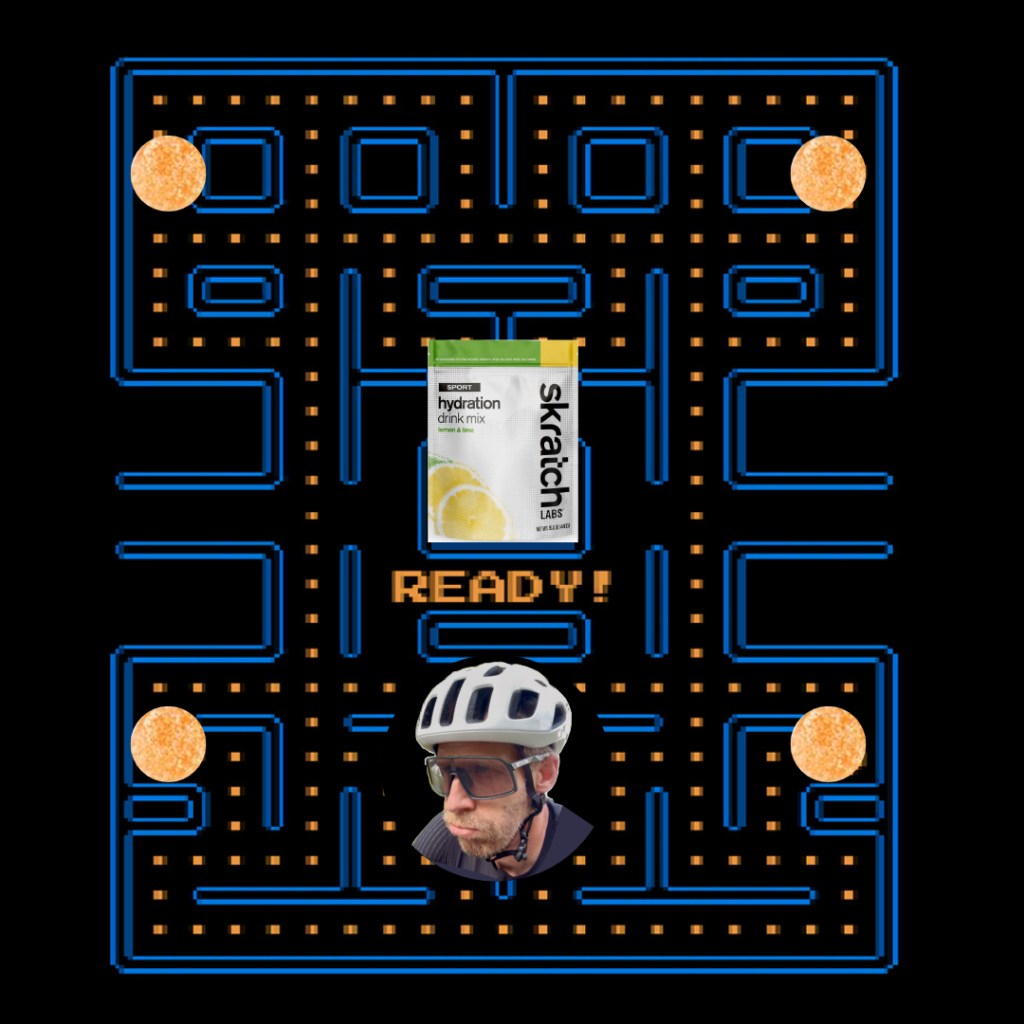
    As an example, I use Skratch Hydration mix. Skratch recommends 1 scoop of 22gr of powder per 450/500ml of water.

    The result in terms of energy intake is:


    Calories80
    Fat0
    Carbohydrate20g
    Protein0
    Sodium400mg
    Potassium50mg
    Calcium50mg
    Magnesium50mg
    vitamin C18mg

    Just randomly drinking water with Electrolytes isn’t enough to maintain sodium levels. Make sure you keep in mind that.

    • Drink regularly, don’t wait to be thirsty.
    • Set timed alerts for food and hydration on your Cycling Computer.
    • Include salt in your food intake like Soups or salty snacks.
    • Avoid salt capsules as some studies doubt they are effective for prevention and can be risky.

    Essentially, during any activity that goes over an hour, or in hot conditions, only drinking plain water can increase the risk of Hyponatremia. Adding electrolytes to your water reduces that risk.

    What about energy gels?

    Energy gels primarily provide quick carbohydrates for fuel during prolonged exercise. Some gels also contain electrolytes, but their main role is to:

    • Maintain blood glucose levels.
    • Prevent early fatigue or even compensate for late fatigue (some gels have caffeine).
    • Provide quick and easily digestible energy.

    Gels can help you with keeping a good energy level through your activity or provide sudden energy needs, while electrolyte drinks helps hydration beyond what water can provide.

    Of course, a lot or people use both in combination, plus a regular intake of carbs.

    Nutrition Strategy

    Before copying an existing nutrition strategy that someone told you about, make sure that you have tested the ingredients before. try alternatives that match your tastes and budget.

    In my case, here is part of my nutrition strategy. It sometimes vary depending on weather, my physical condition and availability of products.

    For my Electrolytes needs, my go to is the Skratch Hydration Powder.

    I find it easy on the stomach and easy to drink. I have never had difficulty diluting it in water even when trying double-dosage.

    They offer many flavours, but I stick to Lemon + Lime.

    • any ride: I mix 1 serving cup with 550ml of water + 550ml of water in another bidon.
    • Long endurace rides:
      • I mix 1 serving cup with 550ml of water
      • I mix 1 serving cup with 700ml of water and I add maple syrup for more carbs.
    • I’ll eat 1 energy chew every 20 minutes for a total of 100 calories and 24gr of carbs over an hour.

    Here is what I would consider to be my hourly intake on a long distance bike ride or event.


    Skratch Hydration 22grSkratch energy chews 10grMaple Syrup Mix 60ml + 22gr Skratch Hydration
    Calories8032220
    Carbs20gr7,6gr54gr
    Sodium400mg18mg0mg
    Potassium50mg4mg200mg

    Keep in mind that any hydration mix of electrolytes is not a one stop shop for your energy source. It has a specific purpose but you need to eat on top of that. I rarely use energy gels but I’ll have real food and energy blocks so I can maintain some sort of performance.

    The main objective of a balanced nutrition stragegy is to prevent Bonking and hyponatremia at the same time.

    What about Gatorade and similar drinks?

    That is a good question. the only answer I have for you is: if it works for you, go ahead and use those products.

    In my case, I can’t drink half a bottle without feeling bloated and it considerably affects my performance in a negative way. I suddenly feel heavy, bloated, and it takes hours for my body to return to normal. I don’t know what in the composition of those beverages makes me feel that way. I wish I could tell you more.

    It’s no-go for me. But I am not saying this is not a viable alternative.

    Please do your own research about these products.

    A Banana?

    Many cyclists carry a banana with them. When 3D printing started, people made all sorts of Banana carrying devices.
    Is a Banana really good for endurance cycling? What are the pros and cons?

    With about 27gr of Carbohydrate per fruit; the Banana can be a good source of energy. With high levels of Potassium, it can help replace some electrolytes lost in sweat.

    Is it most and foremost a natural alternative. It can sometimes complement gels by adding variety to your diet and reduce processed sugar intake.

    Most athletes find it easy to digest, but timing consumption is a must to avoid possible gastro intestinal discomfort.

    The main drawback of the Banana is finding a way to transport it.

    Here is a comparison table showing Skratch electrolyte powder, Gatorade Gatorlyte , Energy gels and a Banana

    1 scoop of Skratch Hydration Powder (in 500ml of water)Gatorade Gatorlyte (591ml)Energy Gel (32gr)1 Banana
    Why use it?Hydration & electrolyte replacementHydration & electrolyte replacementRapid carbohydrateit’s good food
    Calories8050100105
    Does it have electrolytes?Sodium: 400mg
    Potassium 50mg, Magnesium 50mg
    Calcium 50mg
    Sodium: 490mg
    Potassium: 350mg
    Magnesium: 105mg
    Calcium: 120mg
    Sodium: 60mg
    Calcium: 30mg
    Potassium: 422mg
    Carbohydrate 20gr14gr21gr27gr
    Ideal forSerious training and competitionBack-up solutionQuick energy intakeReal food intake
    Sources: skratchlabs.com / pepsico.info / guenergy.com / Canada gov

    Planning a Nutrition Strategy is for you if

    If you are an avid endurance athlete or enthusiast, you need to consider a sport specific food and drink intake. At least while you are doing your activity. It could prevent immediate and delayed health issues while also potentially help you achieve better performances.

    Every year, when I am out on bike tours and bike rides I meet athletes that hit the wall. And I wish I could have shared some knowledge with them prior to seeing them crumbling on the side of the road, 40km away from the hotel or home.

    If bonking is not something you experience ever, perhaps you found a strategy that works for you. Be a sport: Grab a few extra gels or bar and keep them handy to help your fellow (Bonked) Cyclist.

    Looking for Skratch Products in Canada?

    You can order them directly from TRACKLOFT or find them at your local bike shop.

  • When track racing serves you a lemon

    When track racing serves you a lemon

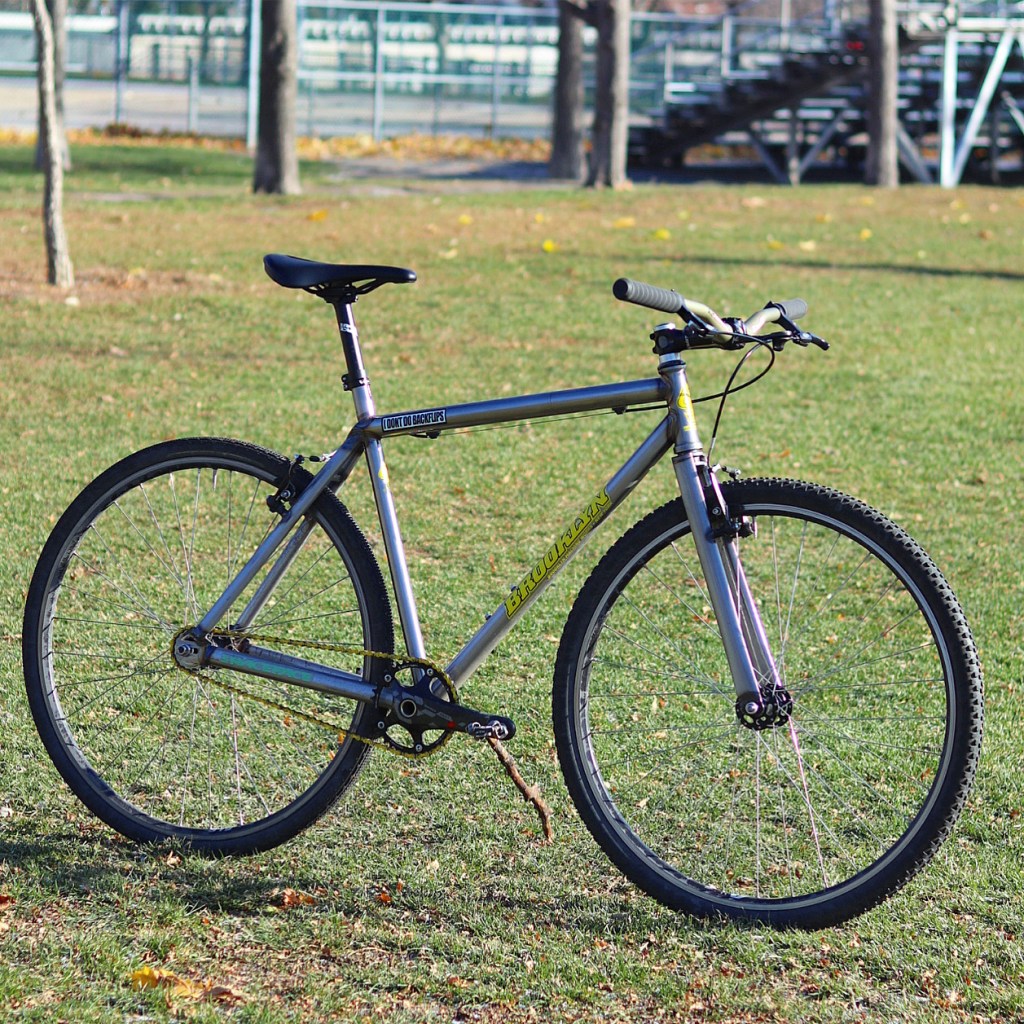
    Is the Brooklyn Machine Works Gangsta V4 a worthy track bike?

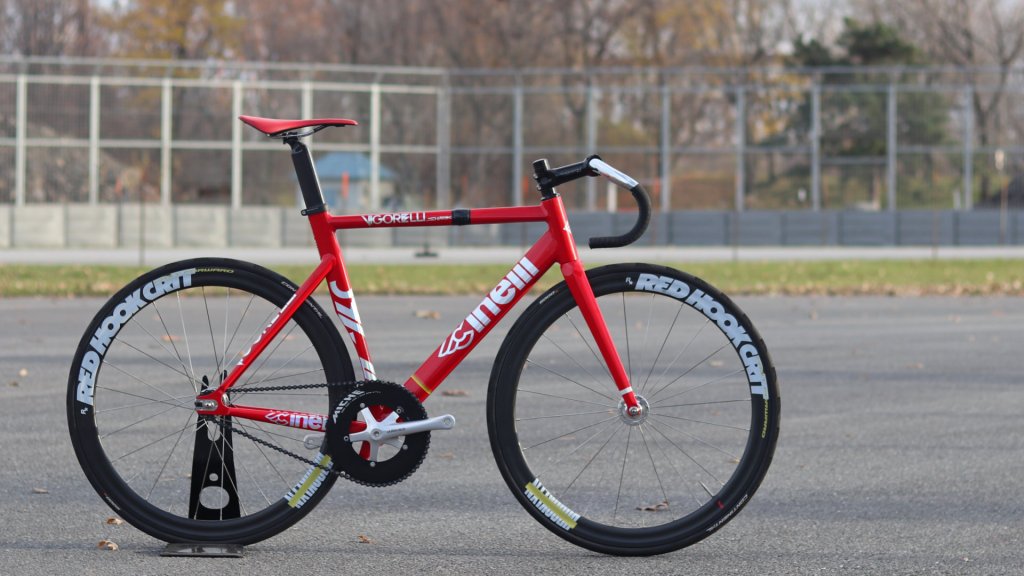
    Not long before my Cinelli Vigorelli Shark was officially banned from the velodrome, I had registered to a 2 day race at the Mattamy National Cycling Centre in Ontario (Canada).

    So I had to quickly turn around and find something to race with. I was expecting Cinelli to send me the newest Vigorelli, which is UCI legal to replace the Vigorelli Shark. But things being what they are since the Covid-19 pandemic, that sponsorship never materialized and so I was stranded on the cote d’azur (so to speak) with no perspective of riding anything but my rollers.

    Then I stumbled upon my Tracklocross bike and took a serious look at it. What if?

    This odd thing has enough clearance for 700×40 tires and yet is built around a track geometry with a steep head angle, high bb drop and short seatstays.

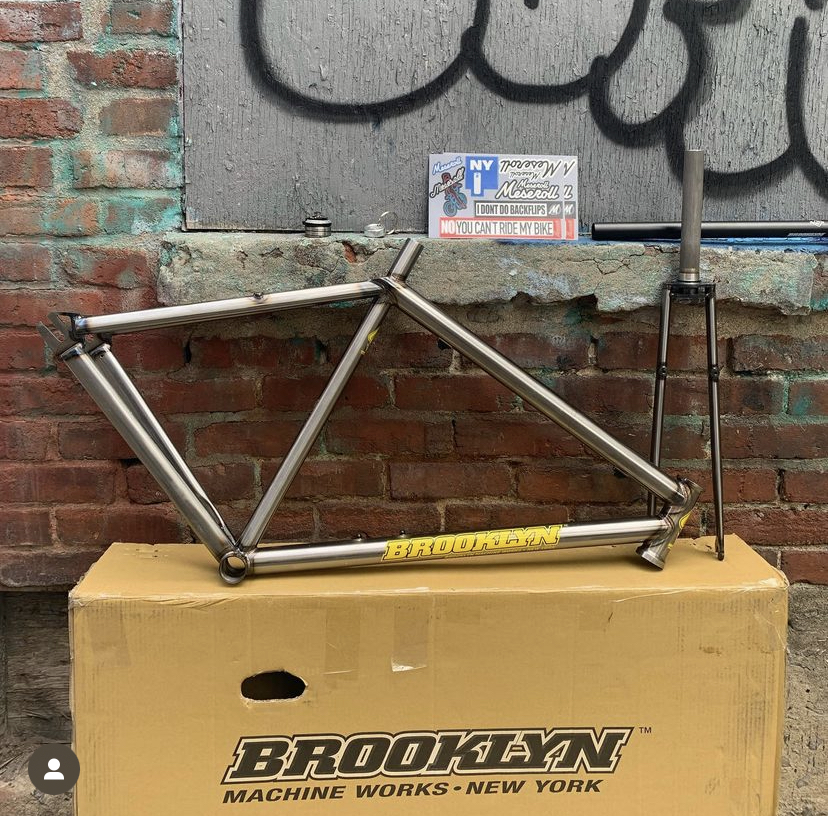
    The Gangsta V4 when I got it out of the box.

    Who the hell are Brooklyn Machine Works

    I purchased my Brooklyn Machine Works Gangsta V4 from a bmx shop in New-York. That frame is uber rare and I was glad I could find one. (although I admit I was looking for a Mash Tracklocross frame set).
    One could say I have a thing for single speed bikes and one would be right! Now, if you don’t know about Brooklyn Machine Works, no one could blame you. They are not really into the road bike, gravel bike and track bike scene.

    It’s a small company that used to make downhill bikes and pretty special ones too! Their design and engineering was unique and their bikes were considered as ”exotic” although they were US based. They became a cult brand and I am pretty sure people are still wondering when, if ever, they will start producing frames again. Here is a short article about them and how still today people look upon them: Brooklyn Machine Works .

    The build

    Although most people ride their Gangsta V4 with a fixed gear and no brakes, I opted for the safer (at least for me) freewheel and v-brake build, all that kitted out with a wide downhill handlebar.

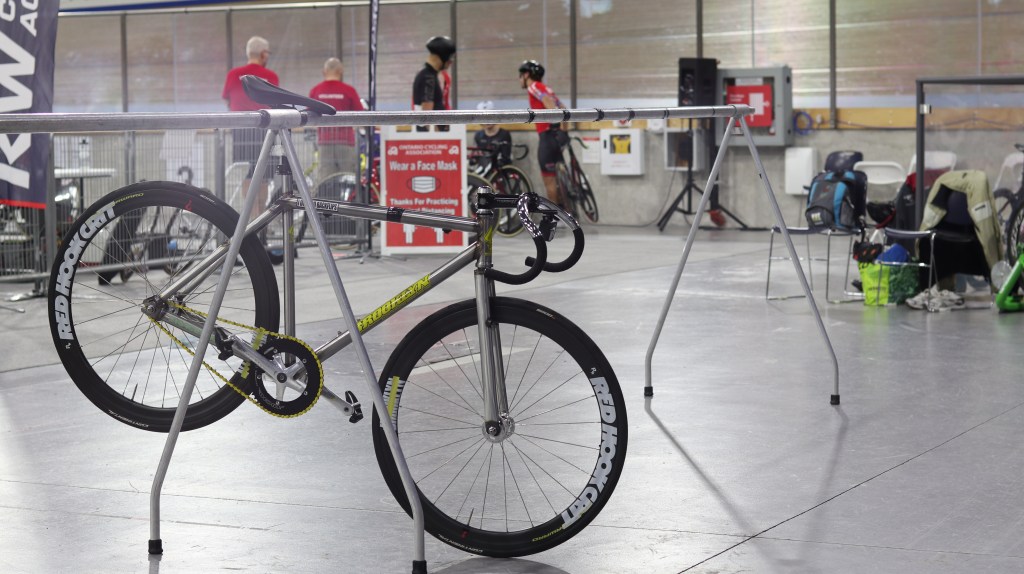
    Originally, I never intended to use this bike as a true Tracklocross bike as I am not skilled enough to handle a fixed gear in any other environment than a velodrome. But now facing the fact I had no track bike for the upcoming event; I decided to remove the ”locross” from the Tracklocross and convert the bike to a simple steel frame track bike.

    Watch the build video here!

    Andreas riding the Brooklyn Machine Works Gangsta V4 Tracklocross bike.

    So I went on and removed the v-brake bosses and installed all the parts from my Cinelli on the BMW Gangsta V4.
    (If you wonder if there was a V1 and then V2 and eventually a V3 of the Gansta the answer is: Yes).

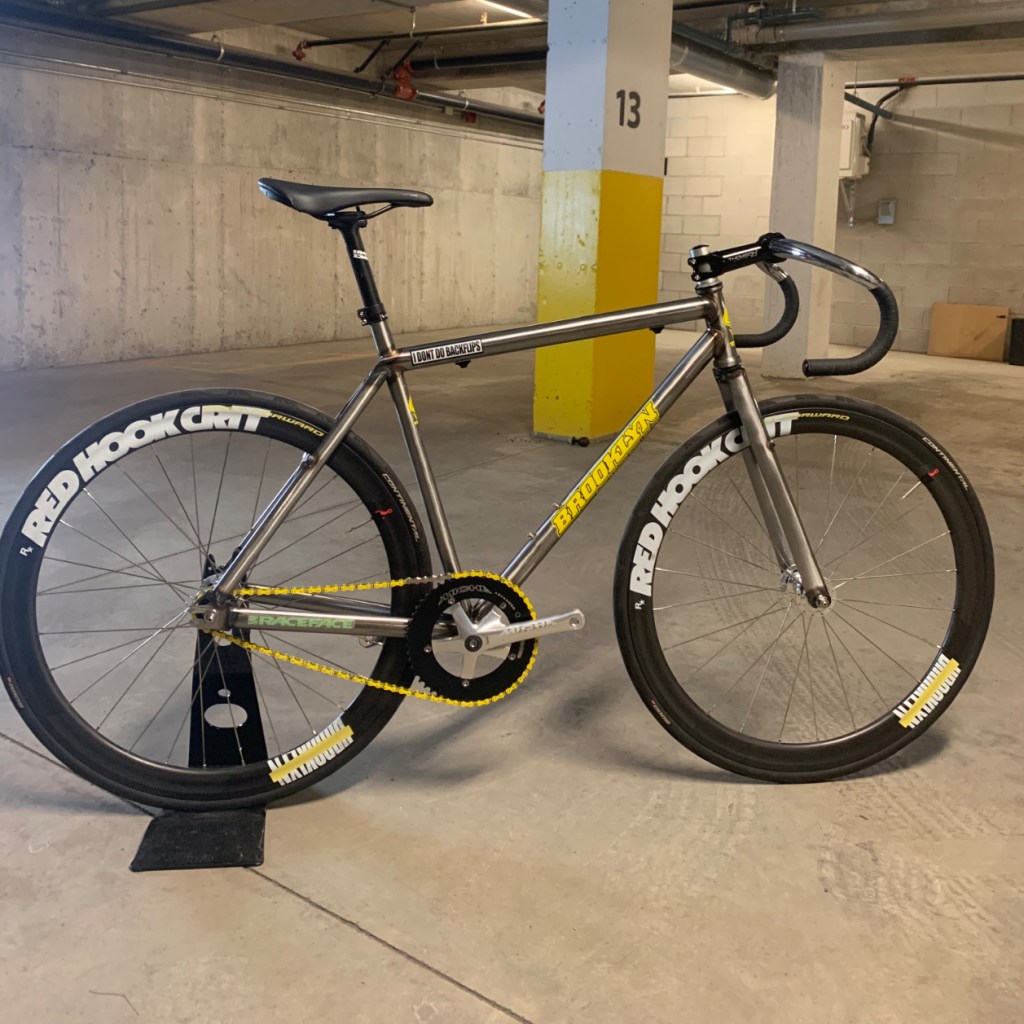
    Specs:

    Frame and Fork: Brooklyn Machine Works Gangsta V4 (Medium)
    Wheels: FFWD Red Hook edition Clincher
    Tires: Continental GP5000 (700×25)
    Crankset: Miche Primato (165mm)
    Chainring: Miche Primato (52T)
    Cog: Shimano dura-ace (14T)
    Stem: Thomson X4 0deg (120mm)
    Handlebars: Deda Velocity (40cm)
    Saddle: Specialized toupé Expert (143mm)
    Seatpost: Raceface Ride 27.2mm

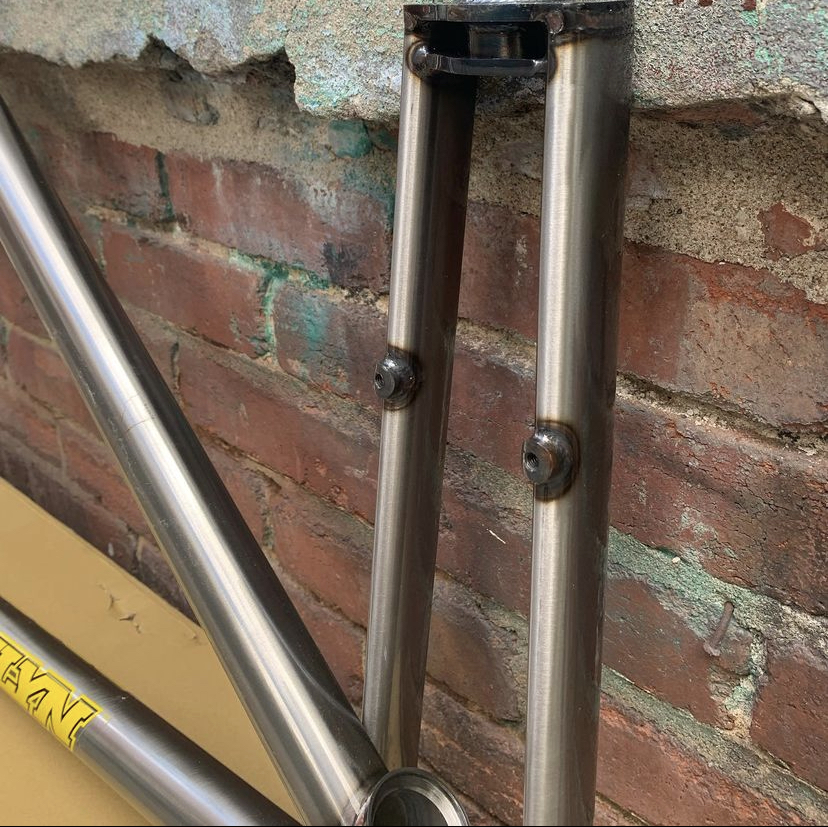
    The Gangsta V4 fork. Bladed tubes and removable brake bosses.

    Riding the track

    The ride feel was better than I expected. The geometry, even with 700×25 tires which I guess the bike was not designed for, handled great on the track. It was predictable and stable with no speed wobble at ”higher” speeds.

    The main downside was the weight. Geeezus it’s heavy. Even with carbon wheels. Added to that was the total unresponsiveness of the bike. Even with top tier quality parts like Miche Primato cranks, a Izumi chain, carbon wheels and a dura-ace cog; power transfer felt like I was driving the rear wheel with a rubber band instead of a high quality 1/8 track chain.

    Am I blaming the bike for my somewhat bad performance at that event? Absolutely not. When you can’t perform to your full potential because of inadequate equipment, you can still try to perform good enough by adapting your tactics and racing smart. Which I tried to do to the best of my abilities.

    Andreas riding the Milton velodrome on the Gangsta V4 frame set assembled for track racing.

    So if you are wondering if you Gangsta V4 is Track worthy, (you would be one of the very few to own such a frame) well I’ll say this: Yes it’s good for track. But it is not good enough for high level racing for many reasons:

    • The frame and fork are heavy
    • I doubt the fork is UCI legal
    • It sure is not aerodynamic
    • It is not the stiffest frame for track racing (although stiff enough for Tracklocross)

    Never again

    Although the whole ”riding a funky bike at a national event” experience was worth it, I retired definitively the Gangsta V4 as a track bike and went on to find something else (more on that later).
    The track scene is rapidly growing in Canada and it is a good thing for our sport. It also means that people are investing more time, effort and money into track racing which creates some levels of inequities when it comes to the stuff people race with.

    I was fortunate enough to find a unlikely replacement bike within my own collection of bikes but also realized that things got serious at the velodrome. Now the gear you use has an immediate impact on performance, provided that you have enough race sense to be able to race track events (which comes with training and experience).

    I am not saying that everyone should go out there and buy an expensive carbon frame. But my advice would be to find a good quality alloy frame, like the new Cinelli (if you can find one) and kit it out with good parts. Finding good tubular wheels is a must. Don’t spend too much on things like the handlebars and other periphery components.
    The real deal is in the wheels and the drivetrain. Once you got that figured out you’ll see what’s your next best move. Purchasing good rollers could also be a nice thing. I digress…

    If you are curious about Tracklocross, I’ll have a few articles about that really cool discipline.

    Steel’s for real, but sometimes it’s just just real enough to make a good post race recovery lemonade.

    Side by side: The Track build and the Tracklocross build

    Here is my youtube video about my weekend at the track riding the Gangsta V4 as a track bike.
  • Project Cinelli

    Project Cinelli

    Finding motivation through a new challenge

    Looking to spice up your local crit racing scene? I did, and here is how it went.

    We have a local crit series for Masters in the Montreal area. And I have been attending those races for a while now, probably since 2008, on and off. So after a while, a few podiums and the repetitiveness of doing the same race series over the years I was kinda looking for a new challenge. The question was: How can I keep the my stoke level high, while I was kinda getting bored from doing those same races over and over again?

    And I had this idea, in the back of my head, for a long time now. I eventually sat down with Josh at Ibike and we talked about racing. The whole crew (my race team) is (was) kinda new to the racing scene and I am for sure at the opposite of that. So I did not want to kill the vibe; While everyone on the team was looking forward to the next event, I was looking away for something else.

    I told Josh: What if I raced a single speed crit bike? Not a fixed gear crit bike but a freewheel single speed bike, with 2 brakes!

    And the project started like that. Of course, the bike could also be used on the track (although I knew it would not pass the UCI inspection. More on that later or in another post).

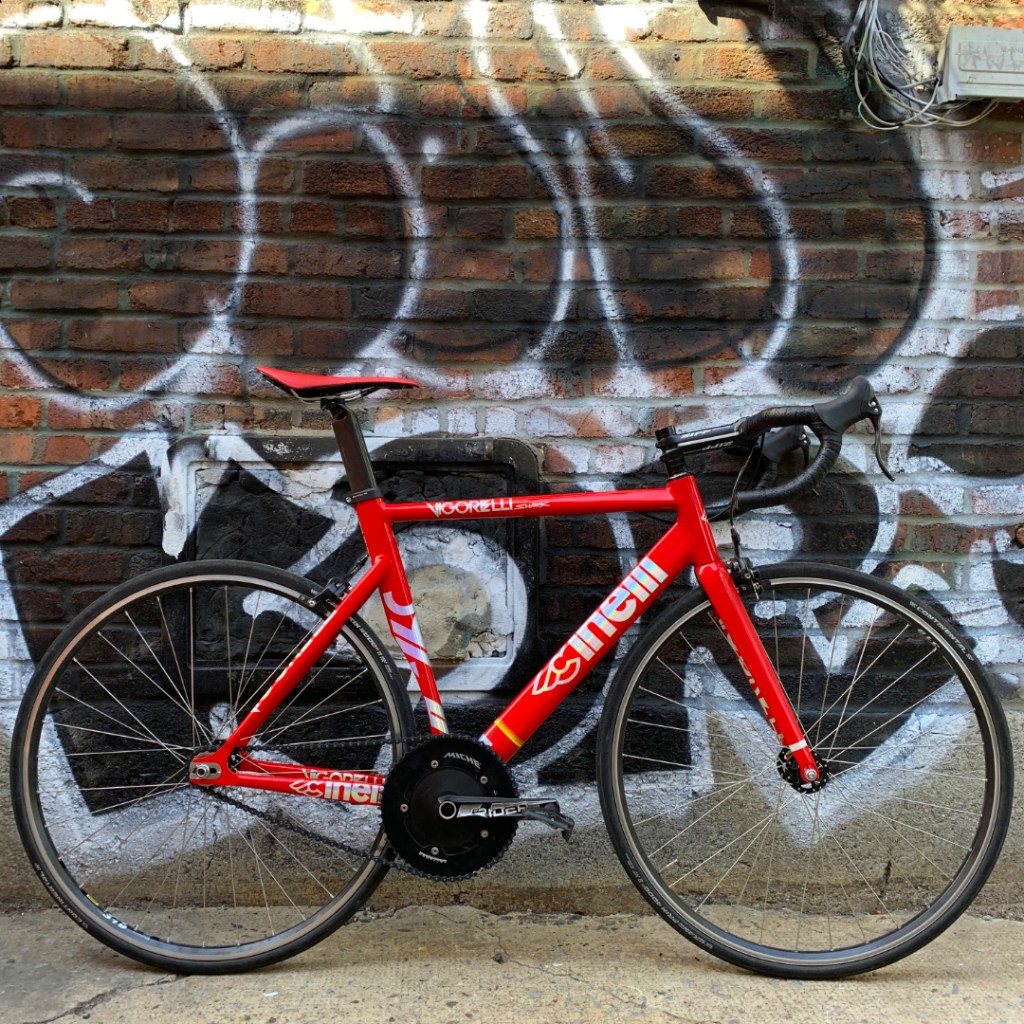
    Josh came back to me a few days later and I was stunned to be handed a brand my new Cinelli Vigorelli Shark Frame set (like fully sponsored!). I quickly went back home and started gathering parts for my project.
    The main concern was to find an appropriate gear to sustain the race speed, accelerations and hopefully take part in the final sprint.

    The Cinelli Vigorelli Shark build for criterium racing.

    The build

    Road Version:

    Cinelli Vigorelli Shark (M)
    Mavic A319 32h rims
    Formula Track hubs (sealed bearings)
    Ridea Crankset (I replaced it with a Shimano since the build video)
    Izumi chain (straight from Japan!)
    Specialized Toupé Expert saddle
    Zipp Service Course Stem (130mm)
    Zipp Service Course HB (42cm)
    Cheap Tektro brake levers
    FSA K-Force Brakes
    Gear Ratio: 56/16

    Track Version:

    Cinelli Vigorelli Shark (M)
    FFWD Redhook Edition Clincher wheels
    Ridea Crankset (I replaced it with a Shimano since the build video)
    Izumi chain (straight from Japan!)
    Specialized Toupé Expert saddle
    Thomson X4 stem 0deg (120mm)
    Deda Velocity steel track bar (40cm)
    Continental GP5000 700×25 tires
    Gear ratio: 51/14, 52/14, 56/15

    See the build video here!

    The purpose

    So I build this bike to race criteriums. There was no doubt in my mind it was a cool idea. I was so motivated by this project that I did not care about the ”pure” fixie haters who were commenting about me running brakes and I did not care about all the 15k$ bikes I would have to go against. In fact, it was even a motivation for me.

    The bike is somewhat ”UCI legal” in the sense that it has 2 brakes, a freewheel mechanism, spoked wheels, a road handlebar… basically, all the stuff one would find on a regular road bike minus 10 sprockets or so. On the other hand, I knew the frame was not UCI legal because of the ”fin” featured under the BB, hence the Shark name.

    But honestly, when you show up at a local criterium race, I don’t think anyone would be bothered to complain about that feature considering it does not give any advantage to the rider and causes no danger to the other competitors.

    My goal was to perform with that bike to a similar level that I would with my regular road bike. And that is all I had in mind.

    First race

    Our local crit series is close to where I work, and live. So my first time riding the bike was on my way to the event. Riding at a warm-up/commuting pace with a single speed bike is not something strange to me. But doing it with such a huge ratio is. It didn’t take long before I started thinking this was a bad idea.

    I got on site after riding 40 minute at probably 70rpm and I thought it would not go well. My legs were heavy. The race format is quite simple. All categories start at the same time and there are 4 final sprints. Basically, the faster guys finish first and so on, with 2 laps between each final sprint.

    In the race, I was surprisingly satisfied with my gear selection. I could easily follow the 43-45km/h average and survive the few 50km/h bursts here and there. Anything faster was really hard and I had to rely on those distant high cadence drills from my track days.

    I finished 3rd on that race. I knew I had something going on. It was a great feeling.

    Technicalities

    You might wonder why am I relying on a huge Chainring and quite easy freewheel combination. So I’ll explain why I went for that specific gearing and also why I didn’t have much choice.

    Most track bikes have a rear wheel spacing of 120mm; So does the Vigorelli Shark. So I had to use a track hub. They do come in various declination of configurations but the axle always measures 120mm:

    • Fixed (single side)
    • Fixed (dual side)
    • Fixed/Free (commonly called Flip-Flop)

    The thread size on those hubs, to mount the fixed cog or the freewheel, is 1.37 x 24 tpi. The freewheel threads are usually deeper to accommodate the freewheel but you could ultimately install a freewheel on a Fixed only hub. The freewheel would hold on with less threads but I am confident that it would hold well for most cyclist.

    That thread size is a limitation when it comes to freewheels. As a matter of fact, to be able to fit a freewheeling mechanism in between thread and a cog, you need some real estate that dictates the minimal inside diameter of the cog. Therefore, unless you run a BMX hub, with a spacing of 110mm and a thread of 30mm x 1, you can’t use anything smaller than a 15T freewheel. They just don’t exist.

    So this led to finding a big enough chainring that would allow me to have a nice cadence in most race situations but that would also clear the chainstays. In fact, the first crank I used for that build was a Miche Primato and the 56 would rub against the chainstay because of the narrow chainline. The Ridea solved that problem for a while until I eventually wanted to try a 59 chainring. The Shimano Dura-ace track crank set was the final option and last one that I tried. I works, but it does rub sometimes under extreme sprint loads. (anything above 1700w will make the chainring rub a bit against the frame).

    If you are looking for a ressource to determine your maximum speed at any given cadence, with a specific tire size you should refer to Bikecalc.com . It is a very useful ressource that I often use for custom Gravel bikes when people consider going 1x and fear they will lack high or low gearing.

    Here is a grid specific to my Cinelli Vigorelli Shark set-up.

    Final speed calculation based on gear ratio and tire size.

    Considering how ”light” the gear is in a race that averages around 44-45km/h, is was quite hard to sprint against guys using road bikes. In fact, I had no punch, no torque so to say, to initiate my sprint. So I had to resort to sprinting while seated at a high cadence.

    Adapting my race strategy

    Considering the limitations I had I decided to stop concentrating on the final sprint and decided that it would be better for me to try to launch an attack with a little under 3km to go. That light ratio still allowed me to punch quite fast to create a break in the peloton and hopefully start a small breakaway with a few willing guys.

    Turns out that no one wanted to follow those attacks and I ended winning 3 or 4 races in a solo breakaway.
    I felt like the Houdini of crit racing, being able to escape the pack and win solo.

    Bridging to existing breakaways and holding on with the faster guys was quite a challenge. The lack of torque and the high cadence meant I was limited to hold on the wheels and skip pulls as much as it was acceptable.

    Another solo win on the Cinelli Vigorelli shark.

    Fun fact

    In a humble way, as I was proud of going on with this project and the results I got. In fact, I am pretty sure this is the first time anyone attempts this, at least in the Quebec province. But it did not catch on with other racers. It actually took a while before anyone noticed that I had a single speed bike. And because people got used to the ”Fixie” bike trend, most of my co-racers thought I was riding a fixed gear bike in a road criterium. (Which of course is not ”ok” by any stretch of imagination).

    The Cinelli Vigorelli Shark crit bike is a really nice project but it proves again that like most things in life, you have to do them for yourself and your own personal growth. There was absolutely no hype associated to this adventure, which is ok, but I did feel like it should and could have got more attention and recognition. I guess it is only human to feel so and I eventually got over it.

    What’s next

    We have a race series in Montreal called ”les mardi de Lachine”. It is a very fast criterium with average speeds around 50 km/h. Since the pandemic, it was canceled but apparently it will be back in 2023.

    My goal would be to re-assemble that frame and race those events with the bike. At least once, hoping that I’ll be able to hold on the pack.

    It will require a combination of appropriate gearing and good/optimal physical condition. One of the two can easily be taken care of.

    I’ll let you guess which one it is.