Finding motivation through a new challenge
Looking to spice up your local crit racing scene? I did, and here is how it went.
We have a local crit series for Masters in the Montreal area. And I have been attending those races for a while now, probably since 2008, on and off. So after a while, a few podiums and the repetitiveness of doing the same race series over the years I was kinda looking for a new challenge. The question was: How can I keep the my stoke level high, while I was kinda getting bored from doing those same races over and over again?
And I had this idea, in the back of my head, for a long time now. I eventually sat down with Josh at Ibike and we talked about racing. The whole crew (my race team) is (was) kinda new to the racing scene and I am for sure at the opposite of that. So I did not want to kill the vibe; While everyone on the team was looking forward to the next event, I was looking away for something else.
I told Josh: What if I raced a single speed crit bike? Not a fixed gear crit bike but a freewheel single speed bike, with 2 brakes!
And the project started like that. Of course, the bike could also be used on the track (although I knew it would not pass the UCI inspection. More on that later or in another post).
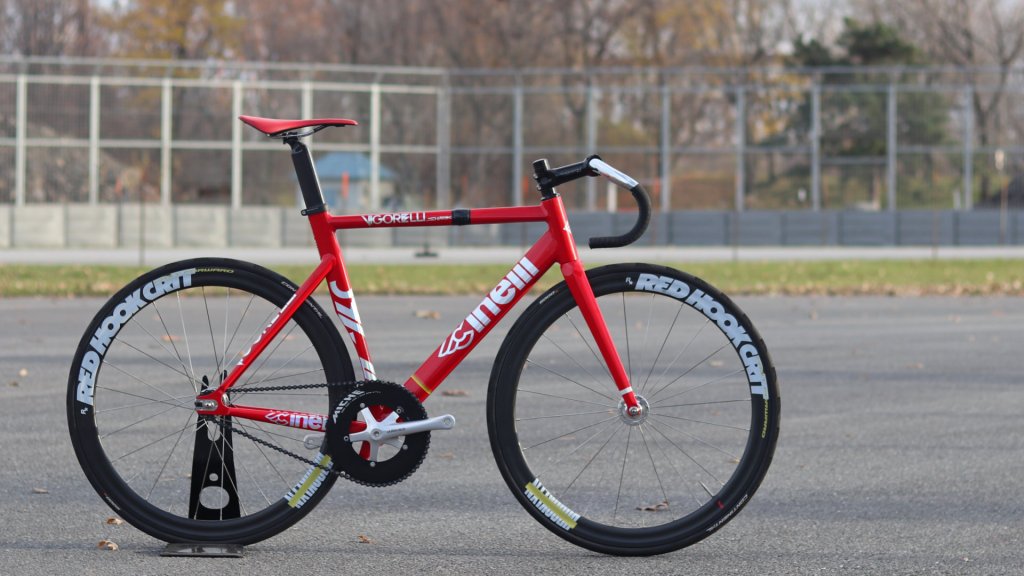
Josh came back to me a few days later and I was stunned to be handed a brand my new Cinelli Vigorelli Shark Frame set (like fully sponsored!). I quickly went back home and started gathering parts for my project.
The main concern was to find an appropriate gear to sustain the race speed, accelerations and hopefully take part in the final sprint.
The build
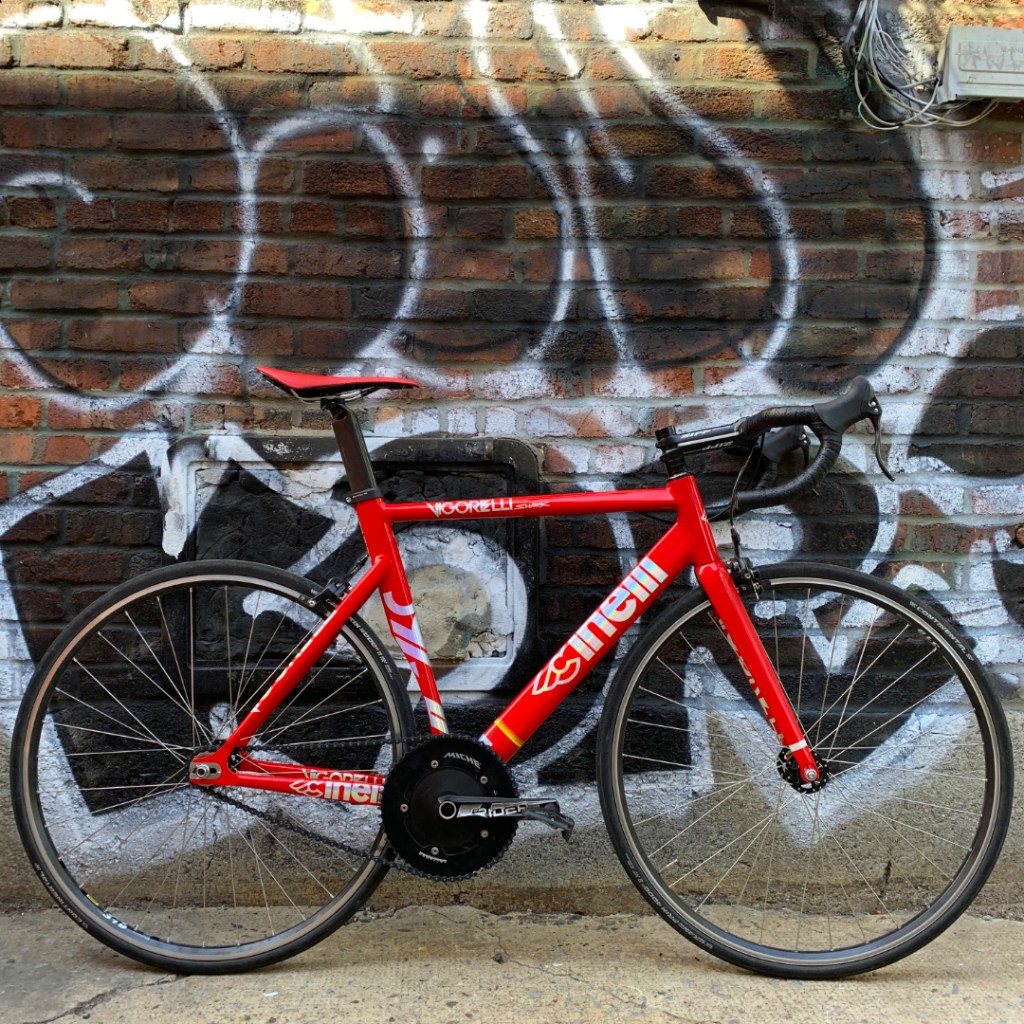
Road Version:
Cinelli Vigorelli Shark (M)
Mavic A319 32h rims
Formula Track hubs (sealed bearings)
Ridea Crankset (I replaced it with a Shimano since the build video)
Izumi chain (straight from Japan!)
Specialized Toupé Expert saddle
Zipp Service Course Stem (130mm)
Zipp Service Course HB (42cm)
Cheap Tektro brake levers
FSA K-Force Brakes
Gear Ratio: 56/16
Track Version:
Cinelli Vigorelli Shark (M)
FFWD Redhook Edition Clincher wheels
Ridea Crankset (I replaced it with a Shimano since the build video)
Izumi chain (straight from Japan!)
Specialized Toupé Expert saddle
Thomson X4 stem 0deg (120mm)
Deda Velocity steel track bar (40cm)
Continental GP5000 700×25 tires
Gear ratio: 51/14, 52/14, 56/15
The purpose
So I build this bike to race criteriums. There was no doubt in my mind it was a cool idea. I was so motivated by this project that I did not care about the ”pure” fixie haters who were commenting about me running brakes and I did not care about all the 15k$ bikes I would have to go against. In fact, it was even a motivation for me.
The bike is somewhat ”UCI legal” in the sense that it has 2 brakes, a freewheel mechanism, spoked wheels, a road handlebar… basically, all the stuff one would find on a regular road bike minus 10 sprockets or so. On the other hand, I knew the frame was not UCI legal because of the ”fin” featured under the BB, hence the Shark name.
But honestly, when you show up at a local criterium race, I don’t think anyone would be bothered to complain about that feature considering it does not give any advantage to the rider and causes no danger to the other competitors.
My goal was to perform with that bike to a similar level that I would with my regular road bike. And that is all I had in mind.
First race
Our local crit series is close to where I work, and live. So my first time riding the bike was on my way to the event. Riding at a warm-up/commuting pace with a single speed bike is not something strange to me. But doing it with such a huge ratio is. It didn’t take long before I started thinking this was a bad idea.
I got on site after riding 40 minute at probably 70rpm and I thought it would not go well. My legs were heavy. The race format is quite simple. All categories start at the same time and there are 4 final sprints. Basically, the faster guys finish first and so on, with 2 laps between each final sprint.
In the race, I was surprisingly satisfied with my gear selection. I could easily follow the 43-45km/h average and survive the few 50km/h bursts here and there. Anything faster was really hard and I had to rely on those distant high cadence drills from my track days.
I finished 3rd on that race. I knew I had something going on. It was a great feeling.
Technicalities
You might wonder why am I relying on a huge Chainring and quite easy freewheel combination. So I’ll explain why I went for that specific gearing and also why I didn’t have much choice.
Most track bikes have a rear wheel spacing of 120mm; So does the Vigorelli Shark. So I had to use a track hub. They do come in various declination of configurations but the axle always measures 120mm:
- Fixed (single side)
- Fixed (dual side)
- Fixed/Free (commonly called Flip-Flop)
The thread size on those hubs, to mount the fixed cog or the freewheel, is 1.37 x 24 tpi. The freewheel threads are usually deeper to accommodate the freewheel but you could ultimately install a freewheel on a Fixed only hub. The freewheel would hold on with less threads but I am confident that it would hold well for most cyclist.
That thread size is a limitation when it comes to freewheels. As a matter of fact, to be able to fit a freewheeling mechanism in between thread and a cog, you need some real estate that dictates the minimal inside diameter of the cog. Therefore, unless you run a BMX hub, with a spacing of 110mm and a thread of 30mm x 1, you can’t use anything smaller than a 15T freewheel. They just don’t exist.
So this led to finding a big enough chainring that would allow me to have a nice cadence in most race situations but that would also clear the chainstays. In fact, the first crank I used for that build was a Miche Primato and the 56 would rub against the chainstay because of the narrow chainline. The Ridea solved that problem for a while until I eventually wanted to try a 59 chainring. The Shimano Dura-ace track crank set was the final option and last one that I tried. I works, but it does rub sometimes under extreme sprint loads. (anything above 1700w will make the chainring rub a bit against the frame).
If you are looking for a ressource to determine your maximum speed at any given cadence, with a specific tire size you should refer to Bikecalc.com . It is a very useful ressource that I often use for custom Gravel bikes when people consider going 1x and fear they will lack high or low gearing.
Here is a grid specific to my Cinelli Vigorelli Shark set-up.

Considering how ”light” the gear is in a race that averages around 44-45km/h, is was quite hard to sprint against guys using road bikes. In fact, I had no punch, no torque so to say, to initiate my sprint. So I had to resort to sprinting while seated at a high cadence.
Adapting my race strategy
Considering the limitations I had I decided to stop concentrating on the final sprint and decided that it would be better for me to try to launch an attack with a little under 3km to go. That light ratio still allowed me to punch quite fast to create a break in the peloton and hopefully start a small breakaway with a few willing guys.
Turns out that no one wanted to follow those attacks and I ended winning 3 or 4 races in a solo breakaway.
I felt like the Houdini of crit racing, being able to escape the pack and win solo.
Bridging to existing breakaways and holding on with the faster guys was quite a challenge. The lack of torque and the high cadence meant I was limited to hold on the wheels and skip pulls as much as it was acceptable.

Fun fact
In a humble way, as I was proud of going on with this project and the results I got. In fact, I am pretty sure this is the first time anyone attempts this, at least in the Quebec province. But it did not catch on with other racers. It actually took a while before anyone noticed that I had a single speed bike. And because people got used to the ”Fixie” bike trend, most of my co-racers thought I was riding a fixed gear bike in a road criterium. (Which of course is not ”ok” by any stretch of imagination).
The Cinelli Vigorelli Shark crit bike is a really nice project but it proves again that like most things in life, you have to do them for yourself and your own personal growth. There was absolutely no hype associated to this adventure, which is ok, but I did feel like it should and could have got more attention and recognition. I guess it is only human to feel so and I eventually got over it.
What’s next
We have a race series in Montreal called ”les mardi de Lachine”. It is a very fast criterium with average speeds around 50 km/h. Since the pandemic, it was canceled but apparently it will be back in 2023.
My goal would be to re-assemble that frame and race those events with the bike. At least once, hoping that I’ll be able to hold on the pack.
It will require a combination of appropriate gearing and good/optimal physical condition. One of the two can easily be taken care of.
I’ll let you guess which one it is.
 Boards and Peaks - Von Westfalen
Leave a comment